
The number that should stop you is not $900,000. It is $212, which is what the whole one-day build cost a solo founder in tools and domain fees.
The viral version of SnapCal says a single day with Cursor, Claude, and Supabase made an app that now pulls $900K a month, and it leaves you wondering whether the blueprint fits in your hands. The mechanics behind that claim are duller and more useful. Version one was code only, written in a day for $212. The first 3,000 signups came from a 42,000-person meal-prep newsletter the founder already owned. Today 72% of new subscribers arrive through paid social, roughly $640,000 a month goes out the door, and about $260,000 is left.
So SnapCal's revenue is real, and the one-day build is a speed tactic that cuts cost, not the growth engine. The repeatable path is a narrow paid utility, a reachable audience, and paid acquisition that pays for itself.
Decide this week which founder you are. If you have no warm list and no ad skill, run a landing-page offer test with a small paid-ad buy before you write any code.
The app is a $4.99 AI calorie tracker

It does one thing: you open the camera, shoot your plate, and get an estimated calorie count back.
SnapCal is a consumer app for iOS and Android, not a dashboard sold to hospitals or a weight-loss program sold to employers. The core v1 feature was exactly that single photo-to-calorie estimate, launched in January 2025. No food database to scroll, no portion sliders, no macro breakdown in that first release. You point, you shoot, you get a number.
That narrowness matters, because the business is a single paid utility.
Access costs $4.99 a month, charged as a recurring consumer subscription through the app stores. One job, one recurring charge. There is no upsell tier, no annual enterprise contract, no one-time $89 license. The money arrives four dollars and ninety-nine cents at a time, which means the entire revenue number downstream depends on how many people keep paying that small amount every month.
This is the demand side of the story, not the build side.
A photo-to-calorie estimate is a small enough product to explain in one sentence and price at the cost of a coffee. It also carries a built-in reason to pay again next month – food logging only works if you keep doing it. Keep that in view: the interesting question is not how fast the app was coded, but whether a narrow $4.99 utility could find enough people willing to photograph their lunch.
| Line item | Monthly amount | What it covers |
|---|---|---|
| Gross revenue | $900,000 | 180,000 subscribers at $4.99 each |
| App-store fees | $270,000 | Apple and Google platform cut |
| AI inference | $38,000 | Photo recognition and calorie estimation |
| Paid ads | $260,000 | Social acquisition driving 72% of new subscribers |
| Payroll | $48,000 | Founder plus four contractors |
| Hosting | $9,000 | Servers and database |
| Other costs | $15,000 | Tools, domain, misc. |
| Net | ~$260,000 | Before owner pay and reinvestment |
The one-day build used three AI tools
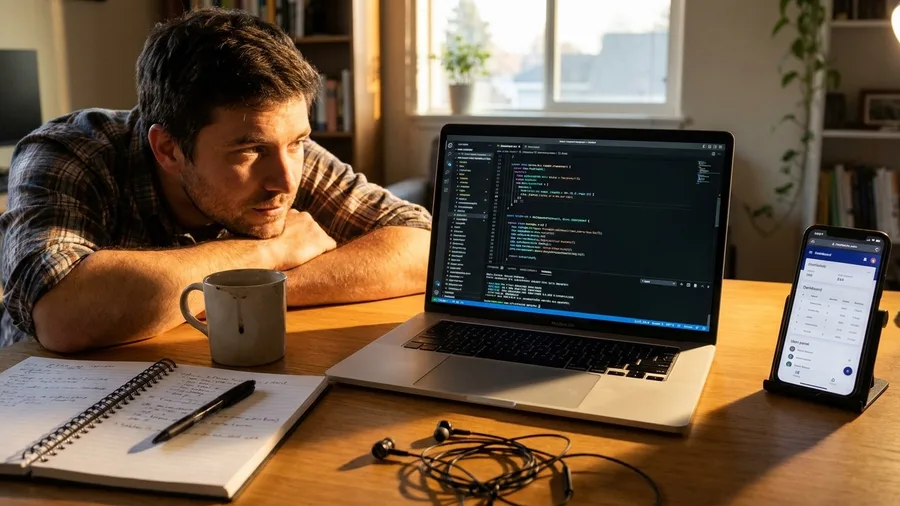
Three tools split the work: Cursor wrote the code, Claude handled the prompts and copy, and Supabase supplied the backend.
No single magic app generator produced the whole thing. Cursor is an AI-assisted code editor, so the founder still wrote and reviewed code with the model completing chunks of it. Claude drafted the prompts that turn a photo into a calorie estimate and wrote the in-app copy. Supabase gave the app its database and authentication without a backend engineer. Total spend across tools and a domain: $212.
That $212 figure is where the viral story gets its pull, and also where it misleads.
The one day covered v1 code only. Design, device testing, the app-store submission, and launch sat outside that window and took their own time. The founder also came in with prior coding experience, which is the quiet condition behind the speed – a first-time developer pointing the same three tools at the same problem would not land the build in a day.
Read the build as a speed tactic, not a business.
Three AI tools plus an experienced pair of hands compressed a small, single-flow app into roughly twenty-four hours of coding. What they compressed was development time on a feature that already had a clear shape. They did not create users, a subscription habit, or a reason for anyone to open the app on day two – all of which the one-day story leaves out.
⚡ What the one-day build actually covered
Cursor sets the skeleton
Generate the basic photo-upload and calorie-lookup flow in one project.
Claude writes the prompts and copy
Craft the AI prompt that turns a food photo into an estimated calorie count.
Supabase handles auth and storage
Connect user accounts and image storage without building a backend from scratch.
Ship the binary to TestFlight
Compile and push a working build — design polish and App Store review come later.
The founder already had a 42,000-person audience
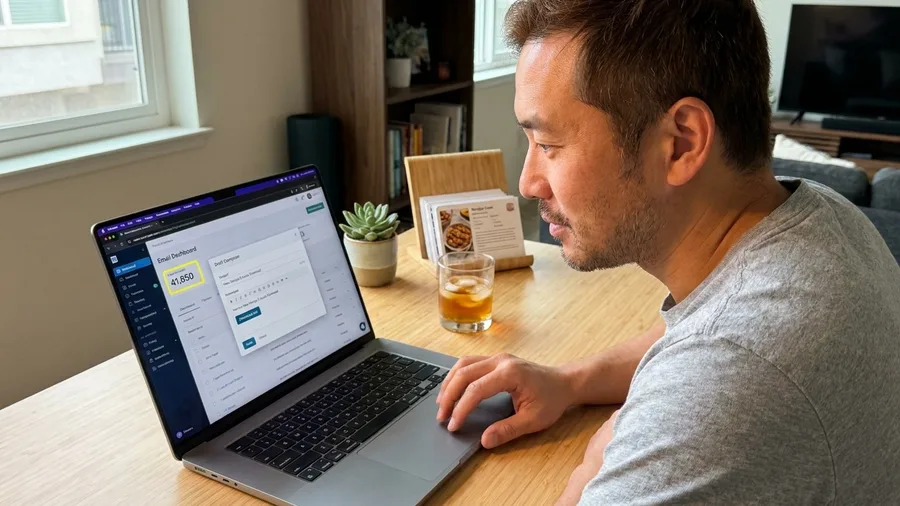
By the morning of launch the founder did not have a cold app sitting on a store page. He had a warm inbox: a meal-prep email list with 42,000 subscribers, built and paid for long before Cursor or Claude were opened.
Those readers knew his name, opened his Tuesday recipe send, and trusted his portions before they ever heard of SnapCal. When he wrote a short launch email with a download link, the first 3,000 sign-ups came from that list, not from a store algorithm or a viral clip. That is roughly the first month of paid-signup volume rolling in for the price of writing an email.
A founder starting from zero has to earn that first demand the hard way. No inbox to send to, no warm audience to ask for a download, so the first 3,000 installs come from an ad spend budget, a cold DM push, or weeks of organic posting that may never convert.
The distinction matters because it is the cleanest line in the whole story between an asset and a tactic. The list existed before day one. The AI tools compressed v1 code but did not conjure a single subscriber, and no part of the one-day build routine creates a warm audience overnight.
Of every factor in the $900K/month story, this is the hardest for a stranger to reproduce.
⚠️ COMMON MISTAKE
The one-day build is not the moat
Copying the AI build without an audience or ad budget gets you a working app with zero users. The founder's list and later ad engine did the demand work — the build only made the product exist.
Revenue is 180,000 subscriptions, not a big contract
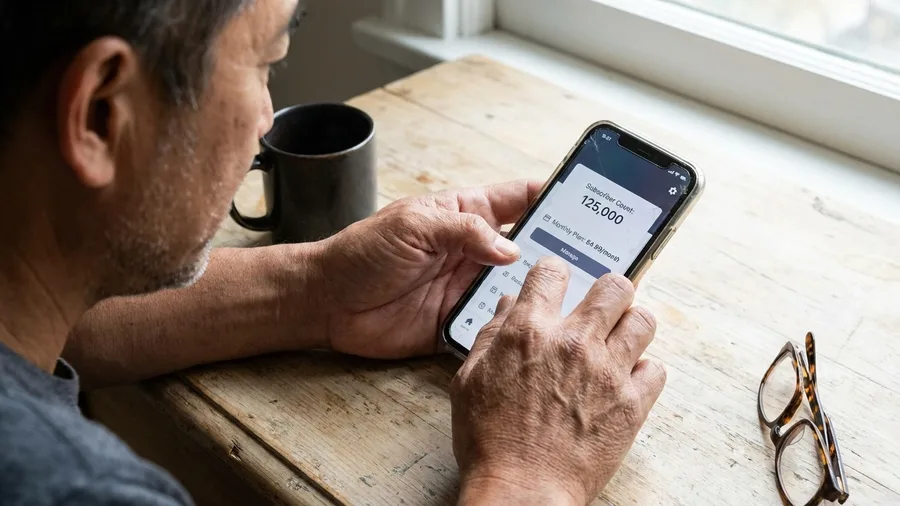
That warm newsletter list covers the earliest signups, but 180,000 paying subscribers at $4.99 each is where the $900K comes from. Run the multiplication and the headline stops being mysterious: 180,000 people, each charged a small monthly fee, stacked into a gross revenue figure. Every payer came in through an app download and a subscription tap, not a sales call.
The money arrives as recurring consumer charges, so the bank balance refills each month as long as people stay subscribed. No single customer rings up a six-figure invoice; no procurement team signs a year-long deal. The $900K is 180,000 separate $4.99 renewals arriving in the same 30-day window.
That distinction matters to anyone planning to copy the model. A consumer subscription business lives or dies on subscriber count, which means every marketing dollar has to buy a new payer and every cancellation erodes the base.
And the $900K is gross. It is the top line before the app-store's $270K cut, before $38K of AI inference, before $260K of ads, before $48K of contractor payroll, before $9K of hosting and $15K of miscellaneous bills. What reaches the founder is the remainder, not the headline.
So the build did not create the 180,000 payers, and it could not. Writing v1 in a day got the product into the store cheaply, but the subscriber count grew from audience and advertising, one $4.99 signup at a time.
App-store fees and AI costs take 34%
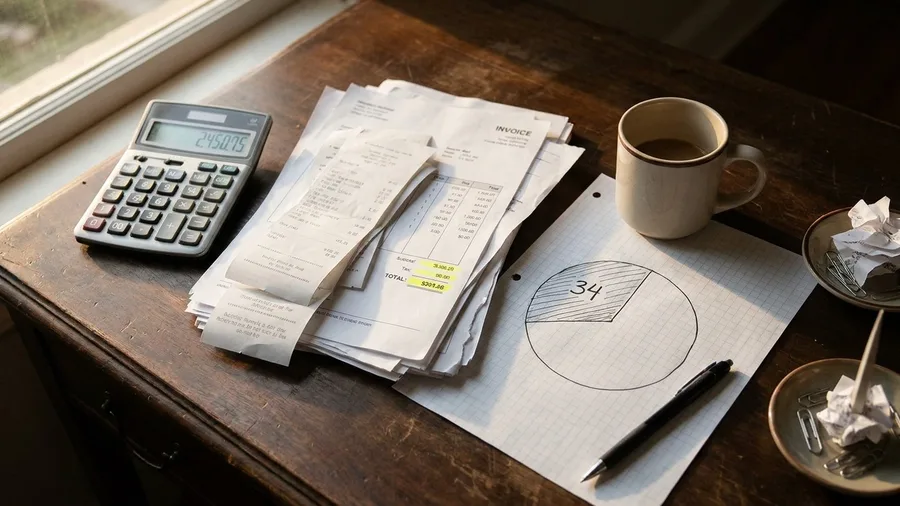
Running the app costs $308,000 a month before a single ad runs or one contractor is paid.
The app-store fees are $270,000, the standard platform cut taken off the top of every $4.99 charge. AI inference – the compute behind every photo-to-calorie estimate – is another $38,000. Together that is $308,000, or roughly 34% of the $900,000 gross, gone before growth and team costs enter the picture.
Those two line items sit at the front of the queue.
The $260,000 monthly ad spend, the $48,000 payroll and the $9,000 hosting bill all come after them. A consumer mobile AI utility carries this shape by default: the store takes its share, and every inference call is a real cost that scales one-for-one with usage. Neither fee shrinks because the app was built in a day – the platform does not care how fast the code shipped, and inference costs the same per photo whether the founder wrote the feature in an afternoon or a month.
Thirty-four percent is the floor, not the ceiling.
Copyable vs. non-copyable — grade your own position
Paid social ads drive 72% of new subscribers
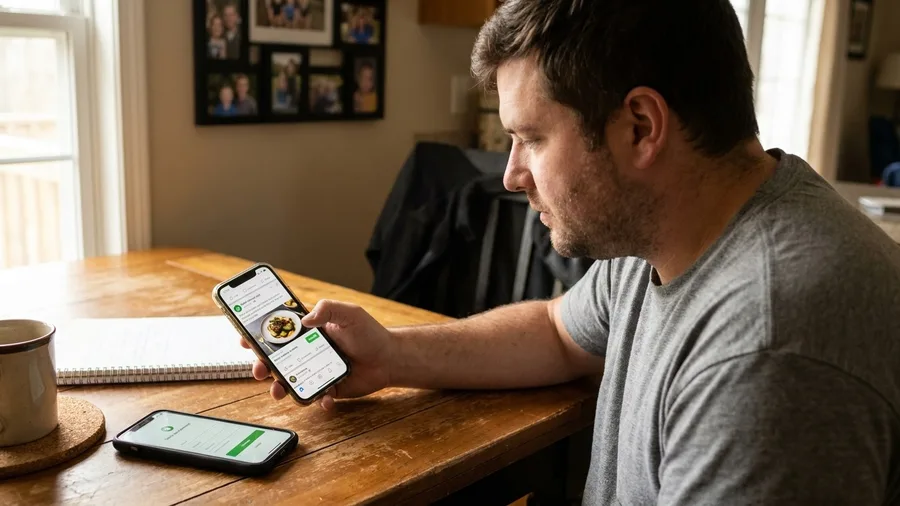
New users find SnapCal through paid social ads: 72% of new subscribers arrive that way, at $260,000 a month in ad spend.
That spend buys subscribers at an average of $18.50 per paying customer. Do the arithmetic against a $4.99 monthly charge and the shape of the business shows itself – each payer has to renew roughly four times before the ad that found them pays for itself. Churn makes that a live question, not a footnote, and the retention numbers decide whether the ad budget is an engine or a leak.
There is no viral loop from the one-day build.
The lunchtime Cursor session is a launch story – a good one, and true. It is not what put 180,000 subscribers on the books. The $260,000 ad engine is what produces demand at scale, week after week, and it is the single largest discretionary line in the cost sheet. A reader with the skill to run paid acquisition at that level has the real lever in hand; a reader who can ship code fast but cannot buy subscribers profitably is holding the smaller half of the blueprint.
The app nets about $260K a month after costs
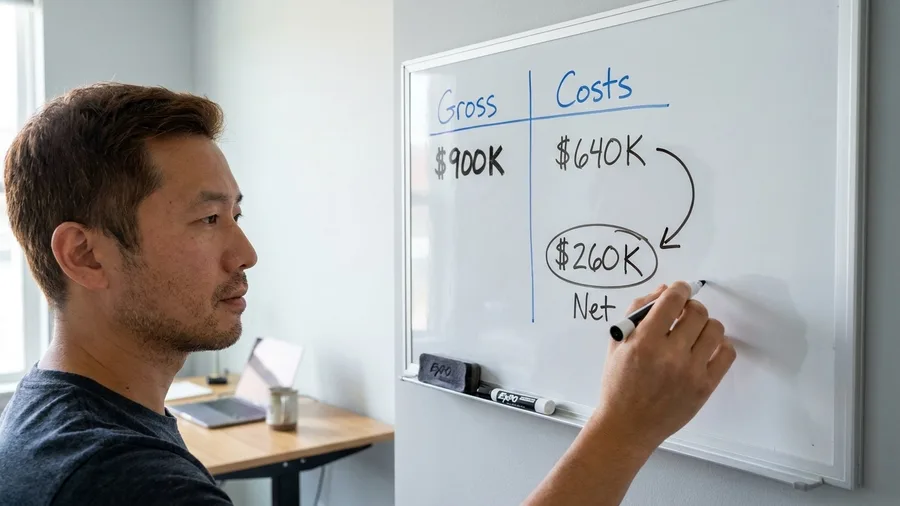
That $260K ad budget is what decides whether anything is left over. The full monthly cost stack turns $900,000 gross into a much smaller number once the platform and the machines take their cut. Apple and Google collect $270,000 in app-store fees each month. AI inference on every photo scan runs $38,000.
Hosting adds $9,000, other costs $15,000, and paid ads $260,000.
Monthly costs land at roughly $640,000. Gross revenue of $900,000 minus that total leaves about $260,000 net per month, a margin near 29 cents on every dollar collected.
The team behind those numbers is the founder plus four contractors covering support, growth, content and iOS maintenance. Payroll for all five runs $48,000 a month, which is lean for a business handling 180,000 paying subscribers and the support tickets that come with them.
That net figure is before owner pay and before any reinvestment. Whatever the founder draws and whatever goes back into product or more ads comes out of the $260,000.
Read the number as a ceiling, not a payday.
The first version shipped with one feature
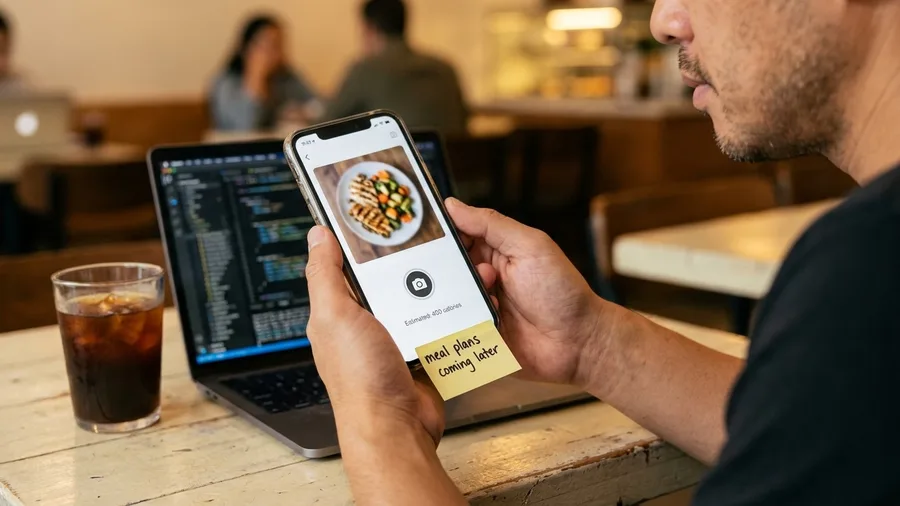
Version one did one thing: you pointed a phone camera at a plate and got an estimated calorie count back. That was the entire product at launch in January 2025, with meal plans and macro breakdowns deliberately left on the cutting-room floor.
The restraint is what made the one-day build possible at all. A single photo-to-calorie flow fits inside a day of Cursor, Claude, and Supabase work; a full nutrition platform with meal planning, macro targets, and food databases does not.
One core job, one screen, one charge.
The extras arrived after the money, not before it. Meal plans and macros were built once 180,000 subscribers were already paying $4.99 a month, which means the founder shipped the smallest thing that could take a payment and let revenue decide what came next. That sequence is the piece a reader can actually lift: find one painful, repetitive task with a clear willingness to pay, build only that, and charge for it before you build the second thing.
The temptation with AI tools is the opposite. Code is cheap enough now that a solo founder can justify a broad roadmap on day one, and the result is three months of features nobody asked for and no paying user to test them against. SnapCal's v1 is a reminder that narrow scope is not a limitation of the build; it was the strategy.
Narrow v1 vs. kitchen-sink v1
Ship one paid job
- One estimate per photo, no meal history
- Charge from day one, $4.99 recurring
- Build cost $212, tools and domain
- Payback before payroll: $48,000/month team
- Add macros only after 180,000 pay
Build the full platform
- Five features, none proven to bill
- Launch slips past the one-day window
- No churn data to fix the weak feature
- Burn runs before the first $4.99
- Skip paid ads until a hook converts
Retention is the real moat, not the build
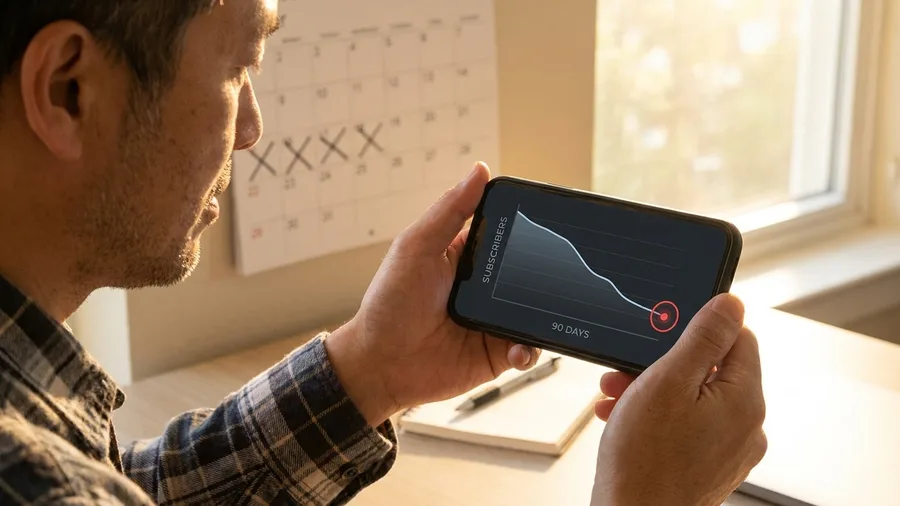
The hard part arrives after the first charge: 41% of SnapCal's subscribers cancel within 90 days, and the monthly churn rate sits at 11%.
That number decides whether the whole model works. When it costs $18.50 in paid social to acquire one paying subscriber, the revenue from that subscriber has to clear $18.50 before they leave.
At $4.99 a month, break-even arrives in the fourth month.
A user who cancels in month two or three never repays the acquisition cost. SnapCal's 41% early-cancel figure means a large slice of every $260K ad buy walks out before the business recovers what it spent to bring them in. The economics only close because enough of the remaining subscribers stay long enough to cover the ones who do not.
None of this is solved by the build. A one-day launch gets a product into the world fast; it does nothing to keep a paying user past month three. Retention is the real moat, and it is built from the unglamorous work that comes after launch: accurate estimates, a fast camera flow, and reasons to open the app on a Tuesday when nothing has changed.
For a founder copying the playbook, this is the number to model first. Cheap code is easy to find. A subscription that survives 90 days is the part that has to be earned.
One-week demand test before you build
Copy the distribution, not the one-day stunt
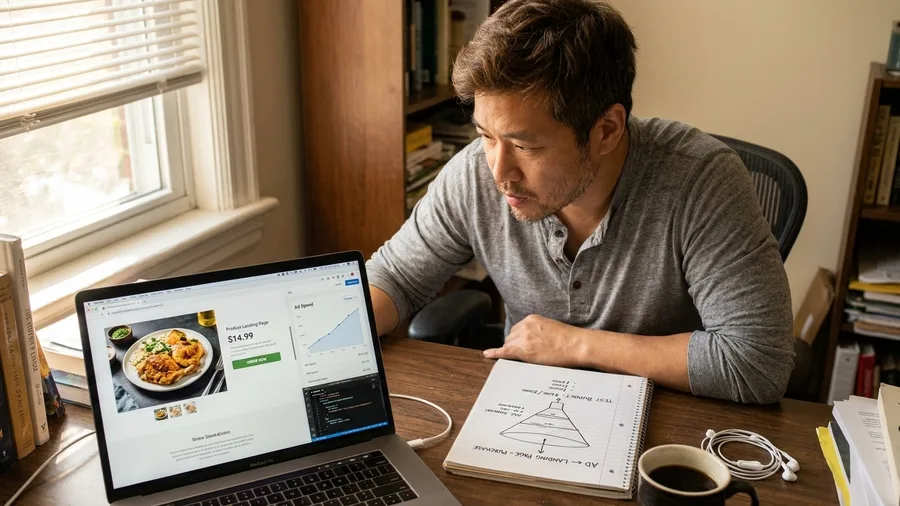
Copy the warm list and the ad account, not the day of coding. Test a narrow paid pain point first: one clear job, one price, one promise that people will pay to solve.
SnapCal's version was a photo that returns a calorie estimate for $4.99 a month. That single job is why the offer works; nobody needs a second feature to decide whether to pay.
The real blueprint has two engines. The 42,000-subscriber meal-prep newsletter gave SnapCal its first 3,000 signups without a dollar of cold traffic, which is the cold-start problem solved in advance.
Then paid social took over: 72 percent of new subscribers, $18.50 per paying subscriber, roughly $260,000 a month in ads. The one-day build cut cost and time; it did not bring a single subscriber.
AI belongs after the demand test, not before it. Build speed matters once people have shown they will pay; building first just makes an unpriced guess cheaper to ship.
So the first step is not a repo. Put up a landing page with the offer and run a small paid-ad buy behind it – $200 to $500 tells you whether strangers click and enter a card.
If you already have an audience or can run paid acquisition, go distribution-first. If you have neither, test demand before you write any code.
Frequently Asked Questions
Can one person really build an app in a day with AI?
Yes, if that person already knows how to code. SnapCal's founder used Cursor, Claude, and Supabase to compress v1 development into a single day, but only because prior coding experience let them debug and connect the pieces. Without coding skill, those tools produce broken snippets that take longer to fix than to write from scratch.
How much did it cost to build SnapCal?
The build cost $212 for tools and domain fees. That covers a Cursor subscription, an API top-up, and the .com domain. Design, testing, and App Store review sat outside that cost and outside the one-day scope.
Is $900K a month profit or revenue?
It's gross revenue: 180,000 subscribers at $4.99 each. After roughly $640,000 in monthly costs — app-store fees, AI inference, paid ads, payroll, hosting, and other — the app nets about $260,000 before owner pay and reinvestment.
What percentage of SnapCal's users come from paid ads?
Seventy-two percent of new subscribers come from paid social ads. The monthly ad spend is $260,000, and the average cost per paying subscriber is $18.50.
What should I copy first from this story?
Copy the distribution-first path, not the build stunt. Test a landing-page offer and run a small paid-ad buy before you write any code. If you already have an audience or acquisition skill, you can skip the audience-building step — otherwise, demand validation comes first.
Why is retention more important than the build speed?
Forty-one percent of subscribers cancel within 90 days, and monthly churn is 11%. At $18.50 per paying subscriber, you need users to stay long enough to recover that cost. Build speed gets you to market; retention keeps you in business.
Build The Landing Page Before The App
The one-day AI build is real, but it is a speed tactic, not the growth engine. SnapCal's $900,000 a month came from a 42,000-person audience and a $260,000 monthly ad engine — neither of which Cursor wrote in a day.
If you have an existing audience or paid-acquisition skill, copy the distribution-first path: narrow paid utility, warm start, paid ads at $18.50 per subscriber. If you have neither, test demand before building. Run a $50 landing-page offer test and a small paid-ad buy. If no one pays, the one-day build just saved you a wasted month.
Test the offer before you test the AI
Write your one-sentence paid utility offer, put a $4.99 price on a landing page, and spend $50 on ads. That data beats a one-day build every time.