
By the end of this page you can decide, this week, whether a faceless AI-run channel fits your life or not. The first number most guides bury: $10,000 in ad revenue at $5-$7 per 1,000 views is roughly 1.4 to 2 million views every single month.
You have a day job, no wish to be on camera, and a quiet suspicion that the $10K promise is another course pitch dressed up as a strategy. Half right. The formula is real in parts: a script, a voice track, a visuals layer and an edit are all buyable, and $80 a month of software, AI narration and stock clips covers three of them. The camera is the only thing actually removed.
What stays is a publishing business. The example channel here runs 12 videos a month at 10-12 owner hours a week, spends $1,800-$3,600 on editing, and does not see its first $10K ad month until months 9-12, with $2,000-$3,500 a month of runway burned before that. That is the ledger, and it is fit and runway that decide this, not tool access. Start with ten videos in one format under a month-one cash cap, wait until the runway exists, or walk away if you need income inside 90 days.
| Line item | Monthly cost | What it buys |
|---|---|---|
| AI script assistant | $20 | First-draft outlines and 1,000-word scripts in your chosen angle |
| AI voice | $30 | Narration track for every upload, no microphone or recording session |
| Stock footage and music | $30 | Licensed clips and background tracks for the visuals layer |
| Editing (outsourced) | $1,800-$3,600 | A 150-300 dollar edit per 8-12 minute video across 12 uploads |
| Thumbnails (if bought) | $0-$600 | 25-50 dollars per thumbnail, or free if made in-house |
| Channel setup (month one only) | $300-$600 | Channel art, branding and first-month launch costs |
A faceless video is four parts you can buy
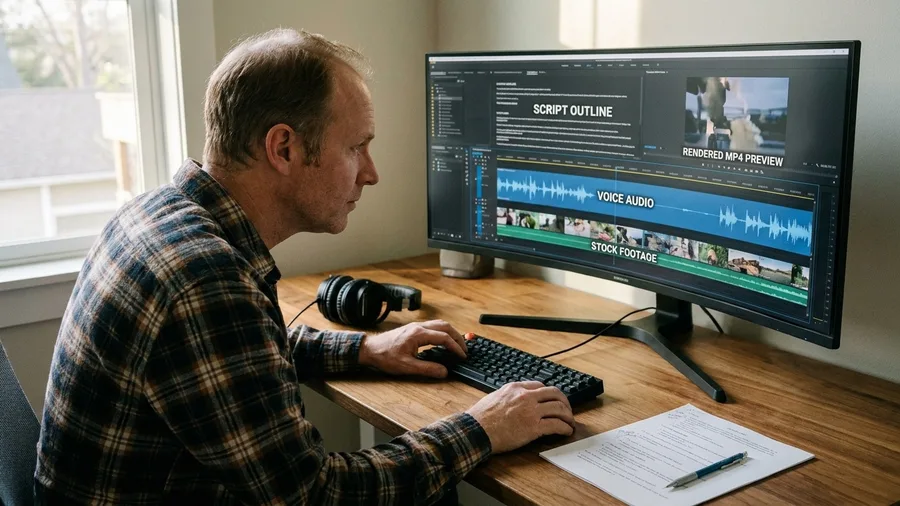
Strip the camera away and a faceless upload still contains exactly four buyable parts: a script, a voice track, a visuals layer and an edit.
Each of those four parts can be outsourced, purchased or handled by a monthly tool, and most new channels buy at least three of them in month one. A 10-minute history video makes the split concrete: a researcher's outline, a $30 AI narration pass over it, licensed archival clips from a $30 stock subscription, and an editor's $150-$300 assembly cut. What lands on the channel is a single MP4 file, one title and one thumbnail image; the viewer sees a finished video and nothing about the supply chain behind it.
Stock clips and synthetic narration are commodity inputs anyone can rent for the same price.
The channel's identity does not live in those. It lives in the script's angle, meaning which facts the video leads with and which it withholds, and in the edit's pacing and clip choices, meaning where the cut lands and which image sits under which sentence. Those two decisions are what a viewer actually responds to, and they are the two a template cannot supply for you.
Buying all four parts keeps the upload moving, but the bought pieces only move the ledger toward the $10K month when the angle is sharp and you approve the edit pass by pass.
One video still eats ten to twenty hours
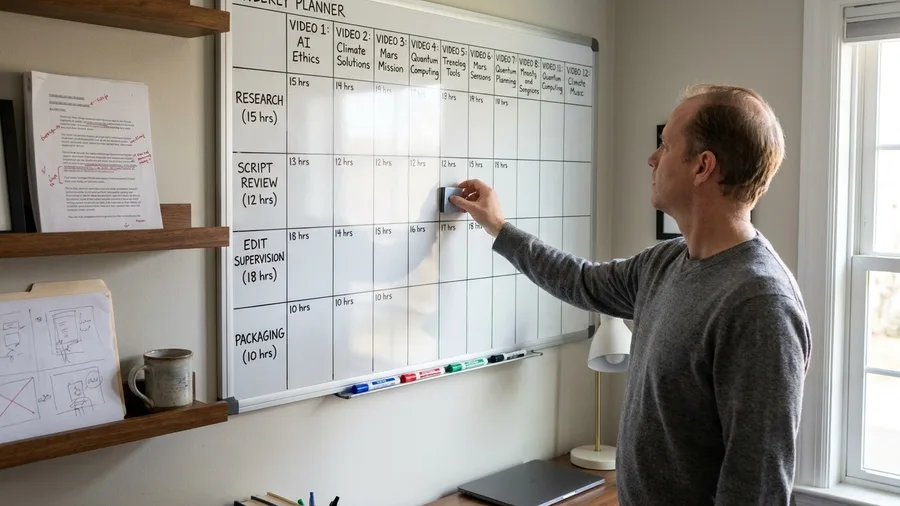
Buying the four pieces strips out the filming; what remains is a stack of hours nobody else can clock in for.
Budget a single 10-minute video at somewhere between 10 and 20 hours of your own time. Finding a subject narrow enough to own, checking it against what already ranks, and settling the argument runs 3 to 5 hours. Reading the script line by line and killing the weak claims costs another 2 to 3. Sitting with the editor's cut, marking the dead beats and the slow clips, takes 2 to 4. Then the title, the thumbnail brief and the upload itself: 2 more.
That last hour is the one people forget, and it is the one that decides the click.
The good news lands after about three months. Once an editor knows the show, the voice tool is dialed in and the thumbnail template is set, 12 videos a month settles at 10 to 12 owner hours a week. The camera was never where the time went.
Cut to 4 videos a month and the library drops from 12 to 4, which drags every format test out three times as long. Two jobs stay yours no matter what you buy: picking the angle and approving the opening hook. An editor can cut and AI can draft, but neither can decide what the channel promises a viewer. Check those 10 to 12 hours against the 1.4 to 2 million monthly views the money needs before you check the budget.
The owner-hour split per video
Where 10-20 hours actually go on a 10-minute faceless upload
AI drafts the script; taste still decides

The speed belongs to the tools; the judgement behind the first 30 seconds belongs to you.
Spend the $20 to $30 a month on an AI script assistant and it will hand back an outline, a 1,000-word draft, a finished voiceover and a list of clip suggestions in the time a coffee takes to cool. That is real production volume, and it is genuinely the cheapest work in the stack.
Then it folds. AI cannot invent an angle nobody else has covered, cannot verify a date or a name against a source, and cannot feel where a script sags in the middle. It will also write the same flat opening as every other channel using the same tool, which is exactly the 40-second exit that kills retention.
So every script gets a review pass before the voice is generated: open the sources and check each claim, cut the lines that could have come from any channel, rewrite the first sentence so it lands like a person talking, and strip anything that smells of a prompt.
Skip the pass and the numbers go quiet. A flat retention curve turns into a flat revenue curve, and no tool line on the invoice fixes that. Eighty dollars a month buys production; it does not buy taste, and taste is what the 1.4 to 2 million views are made of.
💡 PRO TIP
Review the first 30 seconds twice
Read the opening aloud before you approve the voicing. If it takes more than two sentences to state what the video promises, the retention problem is already baked in and no editor can cut it out.
Eighty dollars of software, three thousand of labor

The $80 software line is the cheap half of a two-line bill. The other line – the editor – runs $1,800 to $3,600 a month at 12 uploads.
Add the tool costs up: $20 a month for the AI script assistant that produces the first-draft outline and 1,000-word body, $30 for the AI voice that reads the reviewed script, and $30 for a stock footage and music subscription. That is roughly $80, paid whether or not a single video goes up.
Human editing is the line that decides the budget. An editor charges $150 to $300 per 8-to-12-minute upload, and at 12 videos a month the total lands between $1,800 and $3,600 – twenty-two to forty-five times the software bill for work no tool replaces yet.
Bought thumbnails run $25 to $50 each. Across 12 uploads that adds $300 to $600 a month; make them in-house and the line drops to $0, at the cost of a few owner hours a week.
Month one carries its own charge: $300 to $600 for channel art, a banner and setup, spent before anything is published.
Total the run rate and the number before ads lands at roughly $1,880 to $4,280 a month. The $10K target has to clear that stack and still fund the months when it earns nothing.
Ten thousand dollars is about 1.7 million views
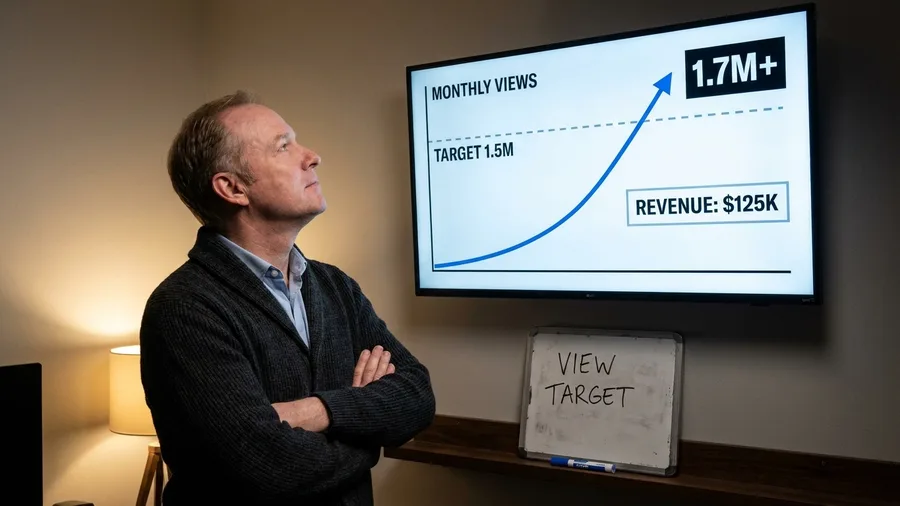
At $6 per 1,000 views, $10,000 a month works out to roughly 1.7 million views – every month, not once.
The rate is not fixed. At $5 per 1,000 views the same $10,000 needs about 2 million monthly views; at $7 it needs about 1.4 million.
That $5-to-$7 band is where the view target lives, and it is set more by what the channel is about and where its viewers sit than by how polished the edit looks. The example channel's English-language explainers aim at US and UK viewers, and advertiser demand shifts sharply from one topic to the next even inside that audience.
One more figure to keep straight: this is gross ad revenue. The terms governing how it is actually calculated and paid belong on YouTube's own documentation, so check the official payout pages rather than a screenshot from a course slide.
The harder part is the repetition. A single 1.7-million-view video proves nothing; the ledger needs that figure or better every month, which means retention that holds across 12 uploads rather than one lucky spike.
The first real payout lands around month six
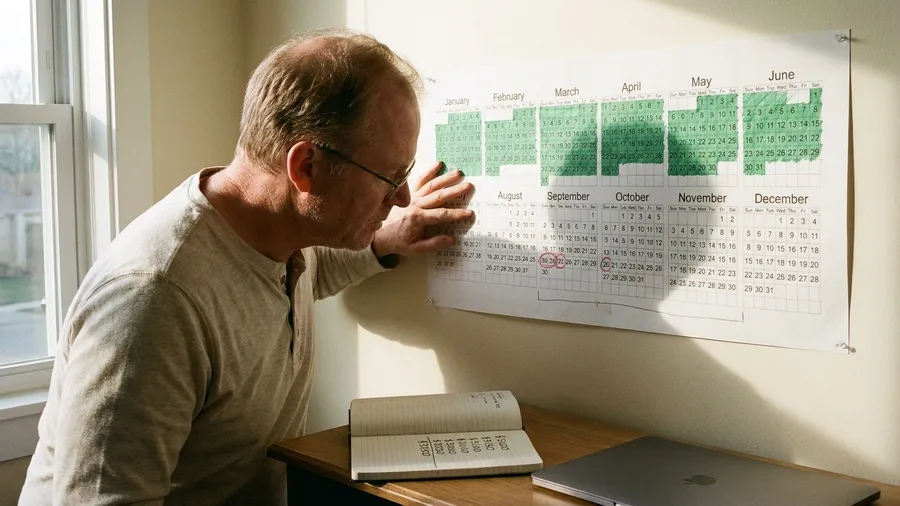
Months 1 through 3 of this build produce no revenue at all – 36 videos published into an audience that does not exist yet.
The monetization review falls somewhere in months 3 to 6, after enough library exists to be judged. Where those eligibility thresholds currently sit belongs on YouTube's official eligibility page, not in a number repeated on a sales page.
Between the first upload and the first payout, the full cost stack keeps running against zero income: roughly $2,000 to $3,500 a month for six months, paid out of the owner's own cash.
Now line up what months 9 to 12 ask for. The $10K ad month needs 12 videos a month, a format already tested and proven, monetization approval, and 1.4 to 2 million monthly views by then – all four at once, not two out of four.
Runway is what buys those months. If the cash runs out before month 9, the bank balance makes the call, not the strategy.
📅 The months between publish and payout
Months 1-3: build the library
36 videos, zero income, $6,000-$10,500 cash out.
Months 3-6: monetization review
In-house thumbnails save $300-$600 a month here.
Months 6-9: first payout
Skip affiliate links and the $9 pack until views stabilize.
Months 9-12: the $10K ad month
At $5-$7 per 1,000 views, gaps cost $500 per 100K.
Ads are often less than half the ten thousand

A single ad line leaves the whole $10K hostage to a view count you don't control. Two side lines fix that: affiliate links in the description, and a $9 template pack sold from a pinned comment.
Together they add $500 to $1,500 in a month at the same 1.4-2 million views, and they often land before the first ad payout clears. A $12 notation app walking a viewer through one workflow converts a few hundred sales in a week; the commission arrives on a net-30 invoice, not a monetization review.
Sponsorships are the heavier line, and they sell on documents. Build the media kit before you need it: viewer age and country split, average monthly views over 90 days, one upload day and hour, and a one-sentence show promise a brand can repeat back to you.
Any channel with a clear topic can run affiliate links and a template pack. Sponsorship fit is narrower, because the advertiser is buying your niche's audience, not the format alone.
Model the $10K as three columns, not one. A $4,000 sponsor deal, $800 in affiliate and pack sales, and 1 million views at $6 leave ads under half the total, which means a soft ad month no longer sinks the plan.
Every extra line pulls owner hours. The media kit, the outreach emails and the monthly affiliate audit have to earn their slot against the 1.4-2 million view target, or they are a second job with no ledger entry.
Ad-only model vs a mixed revenue channel
Ads only
- $10K needs 1.4-2 million monthly views
- One algorithm change can zero the month
- No income before monetization approval
- Least owner hours outside production
Ads plus affiliates and a pack
- Affiliates and a $9 pack add $500-$1,500
- Some income can arrive before ads
- Sponsorships can push ads below half
- More review and admin hours each month
Retention is where faceless channels die

Retention kills faceless channels months before money does. YouTube measures the same thing twice: whether a stranger stays past the first half-minute, and whether the edit gives them a reason to stay. A channel can clear every cost line and still watch its revenue fall to nothing.
The exits cluster around three habits. A first 30 seconds that opens on a slow logo sting instead of the promise, an AI narrator reading generic phrasing with no breath or emphasis, and a channel that adds a new topic every upload so no viewer learns what to expect.
The channels that hold do the opposite early: one format and one promise across ten videos before any new tool, topic or second channel. Ten videos is the point where retention curves flatten enough to read, and where the format is either working or not.
Deleting the channel and starting over is the costly move. The clock resets to zero, the 1.4-2 million view requirement resets with it, and the format tests you paid for in hours are thrown out. The library and the retention data are the assets; a logo is nothing.
A view shortfall costs months, not weeks. The $5-$7 rate does not climb to cover a 40-second drop-off, so a video short of target pushes the 1.4-2 million monthly gate further out every upload.
Retention is the first gate on the ledger. Neither the $80 stack nor $3,600 in editing can buy back the viewers who left before the second minute.
The failure modes, ranked by damage
Reused-content rules decide whether you get paid

YouTube can refuse to monetize an AI-narrated, stock-footage channel, and it has. Its monetization rules single out reused and inauthentic content as a reason to withhold ads, so the answer is not whether the tooling is allowed but whether your output looks like the thing the rule targets.
Read the official monetization and reused-content pages yourself before building anything. A paraphrased threshold from a sales page is not the policy, and the wording shifts. The eligibility numbers belong on YouTube's pages too, not on a course slide.
What separates a passable channel from a flagged one is transformation. Original analysis, sources cited on screen, a point of view the stock clips cannot supply. A voice laid over three generic stock clips is the exact pattern the reviewers are trained to catch.
Even a clean channel gets reviewed eventually. A channel can run unflagged for months and then draw a manual audit, which means no plan should treat monetization as guaranteed.
Put policy risk on the same ledger as dollars, hours and months. It is the one line no software cost covers, and because it can zero the revenue side it can undo every dollar you spent getting to the view target. The safe plan builds transformation into every video from the first upload rather than retrofitting it after a refusal.
⚠️ COMMON MISTAKE
Don't read a threshold from a sales page
Eligibility rules and payout terms change. Check YouTube's official eligibility and monetization pages before you build a budget around a number someone quoted in a course.
It suits a publisher, not a performer

Ten hours a week, about $30,000 of runway, and the stomach to publish the same format twelve times before anything pays. Strip the aesthetics and the channel is a desk with three tabs open: a script doc, an unlisted draft, and a spreadsheet of costs.
Someone who needs the channel to pay rent by spring should not begin it. Before that month-nine window opens, the money only flows one direction.
The review habit is the other filter. Ten minutes of an AI script is fine; an hour is not.
Every claim checked, every generic sentence cut, the first twenty seconds rebuilt until a stranger would stay. Anyone who plans to paste a draft into a voice tool and upload will get exactly the retention that deserves.
What the ledger promises, and no more: a first $10K gross month somewhere in months 9-12 against $1,880-$4,280 of monthly costs. Nothing about that window is owed to anyone.
Start with ten videos in one format, financed only by the $80 stack. That footage tests whether the promise holds past thirty seconds, and no budget can buy that evidence in advance.
Publishing, not performing, is the job. The one saving the whole formula delivers is the camera.
Frequently Asked Questions
Can I really make $10K a month without ever appearing on camera?
Yes, but $10K in ad revenue at a $5-$7 per-1,000-views rate needs 1.4-2 million views every month. That is a publishing business with months of zero revenue before it, not a quick side project. The camera-free part saves time on filming, not on research, review, or editing supervision.
How much does the software actually cost each month?
About $80 a month for the core stack: a $20 AI script assistant, $30 AI voice, and $30 stock footage and music. Editing is the larger line at $150-$300 per video, or $1,800-$3,600 a month at 12 videos. Bought thumbnails add $300-$600 if you use them.
How long before the channel pays anything?
Expect months 1-3 building the library with no revenue. The monetization review sits somewhere in months 3-6, and the first meaningful payout often lands around month six. The $10K ad month is a months 9-12 target, not a month-three one.
Will YouTube demonetize an AI-narrated, stock-footage channel?
YouTube's monetization policies address reused and inauthentic content, and monetization can be refused. Original analysis, on-screen sourcing, and a distinct point of view are what make a channel defensible. Read the official monetization and reused-content pages rather than a paraphrased threshold from a course.
How many hours a week does this really take?
At 12 videos a month, roughly 10-12 owner hours a week once the editor, AI voice, and templates absorb the repeatable work. Each individual 10-minute video consumes 10-20 hours spread across research, script review, edit supervision, and packaging.
What should I do before spending on editing or thumbnails?
Publish ten videos in one format on the $80 stack first. That gives you retention evidence before you commit $1,800-$3,600 a month to editing. If the format does not hold viewers, more editing spend will not fix it.
Who should start on Monday, and who should walk away
The verdict splits cleanly by situation. Ten hours a week and $2,000-$3,500 a month of runway, and you start with ten videos in one format. Need income inside 90 days, and you do not start at all, because nothing here pays before month nine.
The first move is those ten videos, not a purchase. Cap month-one cash at $3,500 all-in, commit the $80 software stack, and buy no course and no gear. The $10K zero-camera-time promise then becomes a ledger question: 1.4-2 million monthly views, 10-12 owner hours a week, $1,880-$4,280 in monthly costs, months 9-12 before the first $10K ad month.
So decide this week: start, wait for the runway, or walk away. The one unforgivable move is buying a course before ten videos have tested the format, because those 1.4 to 2 million monthly views are the only thing that was ever going to pay you.
Run the ledger before you hit publish
Write down your monthly software, editing, and thumbnail spend, your available owner hours, and the month you would need the first payout. If the runway does not reach month nine, the decision is already made.