
What makes the $500-a-day AI posts hard to trust is that they look like product pitches, and almost none of them are. The seller is not moving a tool. The seller is delivering a service a business already pays for, with a model handling the repetitive part so one person can clear more jobs per day.
A dashboard screenshot proves nothing. It never names the buyer, the deliverable, or how many went out that day, which is exactly why the post can promise a number it never has to defend.
All five plays below are ordinary services with a named buyer and a line already sitting in their budget. The $500 is arithmetic: price per job times jobs per day. It is not a setting inside a tool.
Stacks run $40 to $120 a month, there is nothing to buy in advance, and you take a 50% deposit up front on every job. In this example the first paid one lands after 3 to 6 weeks of ten outreach messages a day. Pick a play, memorize its daily volume, and leave with a sample plus ten messages as the week's real task.
Quick Tips Before You Start
10 messages a day
Outreach is the job. Send 10 specific messages to named buyers every morning before you touch a project.
50% deposit up front
Never start work without half the fee cleared. It filters tire-kickers and funds your tools.
Expect 3–6 weeks
Your first paid job lands after about 3–6 weeks of consistent outreach, not in three days.
Price per job, not per hour
Quote a flat fee for a finished deliverable. Hourly billing punishes you for getting faster.
Keep tools under $120/mo
You do not need ten subscriptions. One voice tool, one design tool, one chatbot platform covers every play here.
1. AI voiceover for e-learning and ad shops
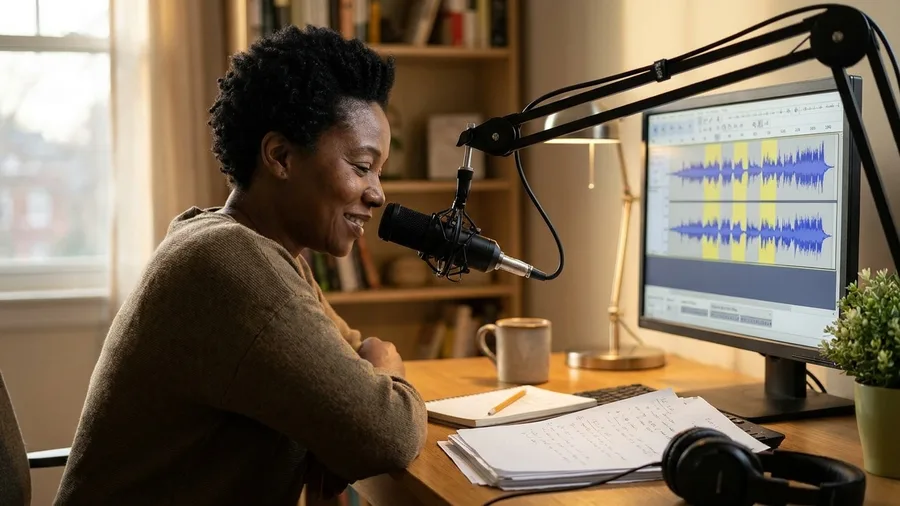
You do not need a voice actor's range to charge voice actor rates. Synthesized and cloned voices handle the narration now, and the work is priced per finished minute, not per hour in a booth.
A finished 10-minute module bills $180 to $250. Two or three of those in a working day clears $500, and the tools behind them run about $50 a month – the lowest overhead on this list.
The buyer is not listening for warmth or breath control. They check three things: that every product name matches the pronunciation guide they sent, that your pickup list names the exact timestamp of any line you changed, and that one revision pass is baked into the rate so they are not re-negotiating.
Pitch two kinds of customer. E-learning studios sit on backlogs of compliance and onboarding modules that never get voiced because the budget for a booth session was cut. Small ad agencies need a scratch read the same day, so their client can approve a script before the shoot gets scheduled.
The catch is real and you should hear it before you build a sample. Some buyers insist on a human voice, and union work carries terms a synthetic read cannot meet. Route around both by aiming at scripted corporate jobs – internal training, product walkthroughs, compliance modules – where the language is fixed and you credit the voice as synthetic in the file.
Start with the cheapest sample on this list. If you want to know which money-making bots survive a real test, see which AI bots pay before you build yours. Take a public course script or a product page, narrate 10 minutes of it, deliver the audio with a pronunciation list and a pickup sheet, and you have proven the whole offer before you send a single pitch.
💡 Tip: Deliver a web-ready MP3 plus a WAV master. Ad agencies will ask for the WAV for edit suites, and having it ready makes you look like a studio, not a side hustle.
| The play | What you deliver | Price per job | Jobs per day for $500 | Monthly tools | Who it suits |
|---|---|---|---|---|---|
| AI voiceover | Finished 10-minute training module | $180–$250 | 2–3 modules | $50 | Writers and detail people |
| Virtual staging | One staged listing photo (6-photo package $180) | $30 | ~17 photos | $60 | Anyone with an eye for rooms |
| Listing SEO | 20-listing batch (audit $500) | $150 | 3–4 batches | Included in subscriptions | Copywriters and organizers |
| Custom chatbots | One local-business build + $150/mo hosting | $1,200 | 2 builds a week | Platform fee | Sales-forward freelancers |
| Clinic automation sprint | One 3–4 day back-office project | $2,000 | 1 project per 4 days | Platform fee | Experienced consultants |
The voiceover offer, before and after
Price the pair at $400–$500; tools cost about $50/mo.
2. Virtual staging and photo cleanup for realtors
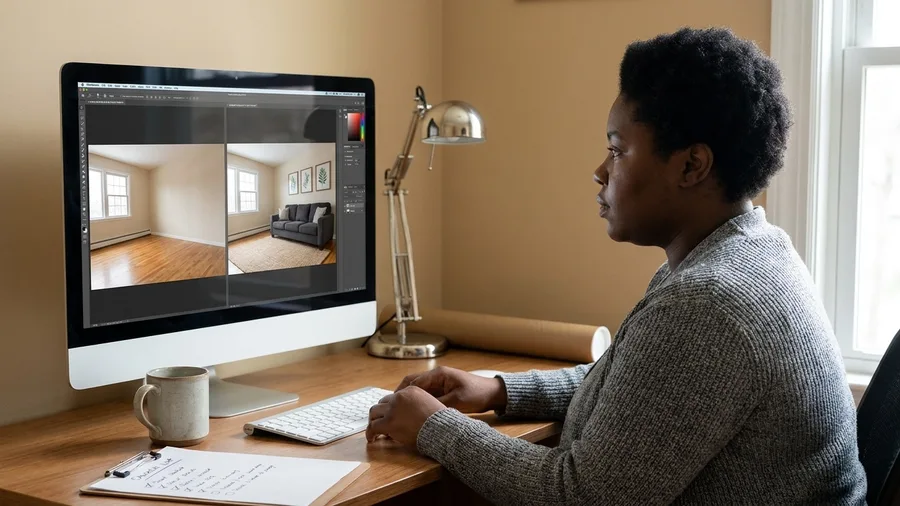
Narrating a module buys you a script, a pickup list and a revision pass. Virtual staging buys you minutes and a clock. This play keeps the same $500 target and slashes the time per job, which only works if you learn to take work in bulk. The number that drives it: $30 a photo. That means about 17 finished photos to hit $500, and you don't get to 17 by working one photo for one client at a time.
The ticket looks tiny until you sell a package. Six staged rooms on a single vacant listing bills $180, because the agent wants the whole property, not a sample. The software that strips the furniture and renders a replacement room, sofa and finish runs about $60 a month – one package covers it twice over.
Realtors pay for speed, not artistry. A vacant house photographs as empty rooms with dead corners, and it sits on the market while it looks that way. The agent has an open house Saturday morning, so the answer they need is a finished set of images by Friday afternoon. That deadline is the product.
The work per photo is a fixed sequence you can time: clear the room of the seller's clutter, drop in furniture and finishes that suit the home's price bracket, relight until the render matches the original exposure, then export a web-size file and a print-size file. Four moves, ten to fifteen minutes each. Seventeen in a day is a production line, not a creative session – so treat it like one and you'll hit the count.
Before any of that, settle the disclosure. Staged images have to be labeled as virtually staged, and the exact wording is set by the local board or MLS, not by a national standard. Call your local board and get the required language in writing, then paste it into every delivery email so the agent never has to ask.
The batching is what makes the day real. Pitch one agent on their three current vacant listings – 18 photos, one Friday, one invoice – instead of chasing 17 separate clients. The buyer signs because of the deadline, and the deadline only pays $500 when the photos come stacked from one listing.
💡 Tip: Ask for the raw photo set and the listing's asking price before you start. A $180k starter home and a $900k property need different furniture, and getting that wrong is how you lose the account.
Virtual staging — at a glance
💵 Deposit up front
50%
📦 Listing multiples
3 listings = 18 photos
🧮 Cash needed to start
$40–$120/mo
🖥️ First paid job
3–6 weeks
⏰ Outreach to land it
10 messages/day
Skip this if
You won't call your local board in writing for the staging disclosure language. No label, no delivery.
3. Listing SEO and A+ content for Amazon sellers

A vacant listing closes when the house sells. A listing's copy decays forever. That is the difference between this play and a photo schedule tied to one open house: here the work renews on a monthly cycle, because competitors rewrite their titles, categories shift, and yesterday's keyword stops ranking next quarter.
Price the batch at $150 for 20 listings. Three or four batches in a working day gets you past $500. The opener that lands the batch conversation is a full storefront audit at $500 – a complete read of their catalog, which tells the seller exactly where they're losing clicks and makes a 20-listing refresh feel like the obvious small next step.
The deliverable has to be something an overworked seller can check in under five minutes. You hand over keyword-mapped titles, five selling bullets per listing, backend search terms, and a before-and-after sheet with the old copy set directly beside the new. The seller compares the two columns on screen without ever opening a keyword tool.
So why wouldn't they just paste it into ChatGPT? Because they hate writing copy, they want one fixed price and one person whose name is on the sheet, and a $150 batch is cheaper than the afternoon their own hire would spend on it. The chat window doesn't send a before-and-after sheet, and it doesn't answer the phone when the bullets need fixing.
This play does not fit everyone. Brand-registered sellers with a content team already own the work. And if you can't read a search-term report well enough to defend your keyword mapping when challenged, skip this one – the seller will ask, and the answer has to come fast and specific.
The batch is the door, not the business. Pitch a monthly refresh at the same batch price, because listings keep decaying whether or not the seller notices. That's how the $500 day stacks: three or four batches from two or three steady sellers, not fourteen one-time buyers to chase down every week. The check is signed monthly, and the arithmetic follows the signature.
💡 Tip: Send the before-and-after sheet as a two-page PDF, old copy on the left, new on the right. Sellers forward that exact document to their business partner to approve the spend.
⚠️ COMMON MISTAKE
Do not quote per listing
Quoting $10 per listing sounds easy to sell and traps you in a 50-listing grind for the same $500. Sell the 20-listing batch at $150 so the unit of work stays predictable and you can defend the price.
4. Custom chatbots for local service businesses
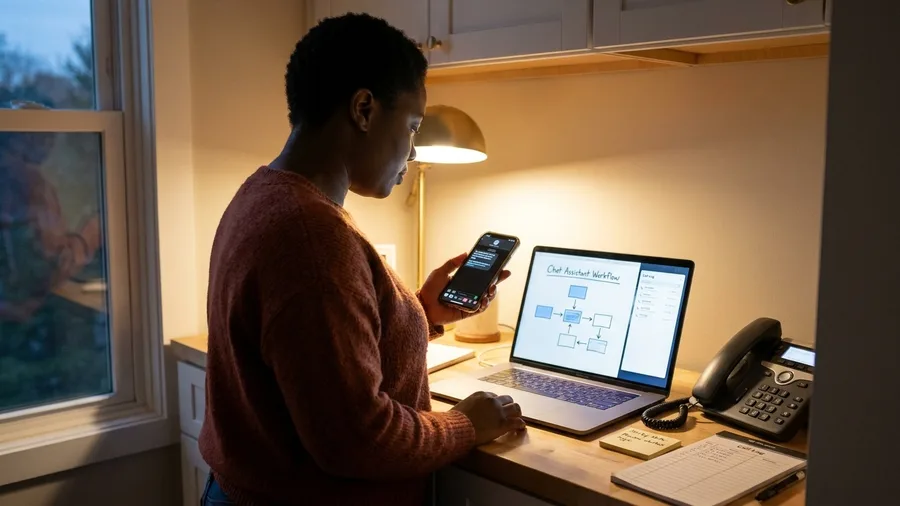
Raise the unit price and the day changes shape. Batch copy work trades at $150 a throw, which is why it takes three or four of them to reach the number. A chatbot build sells for $1,200, so two closed deals in a week average out to $500 a day – and the hours shift off your keyboard and onto the phone, because selling is now the job.
The monthly line is what makes this play compound. Each build carries $150/mo for hosting and upkeep, and that $150 arrives whether or not you land anything new that month. Land four builds and you are already collecting $600 a month in recurring fees, so month two opens with revenue booked instead of a blank calendar.
Your buyer is the business that lets the phone ring out. Dentists, HVAC outfits, med spas and law firms all lose bookings this way, and each missed call is a slot they can price in dollars. Call their main line at 6 p.m. and count the rings – whoever does not pick up has a number attached to their problem and a reason to hear your pitch.
Four things ship in a standard build. You scrape their own site into a knowledge base, wire missed-call capture so a voicemail turns into a texted reply, add a calendar handoff that actually books the slot, and write a one-page handover doc naming who to call the day it breaks. Deliver all four and you have sold a working system, not a demo.
The failure that sinks a reputation is a bot making things up – inventing a price, answering a medical question it has no business touching. Fix it with an escalation rule: any question that falls outside the scraped knowledge base routes straight to a human, transcript attached. Write that rule into the handover doc so the client can see it and hold you to it.
Two builds a week is a sales pipeline, not a to-do list. It runs on ten messages a day to a named list of local businesses, and the realistic clock to the first paid build is three to six weeks of that. Pick twenty businesses within an hour's drive, log every call, and work the list daily until the first yes lands.
💡 Tip: Put the hosting fee on a separate line from the build. Clients accept $150/mo easily when they see it apart from the $1,200 setup, and the recurring revenue is what makes the play worth running.
Who says yes fastest
5. Back-office automation sprints for small clinics
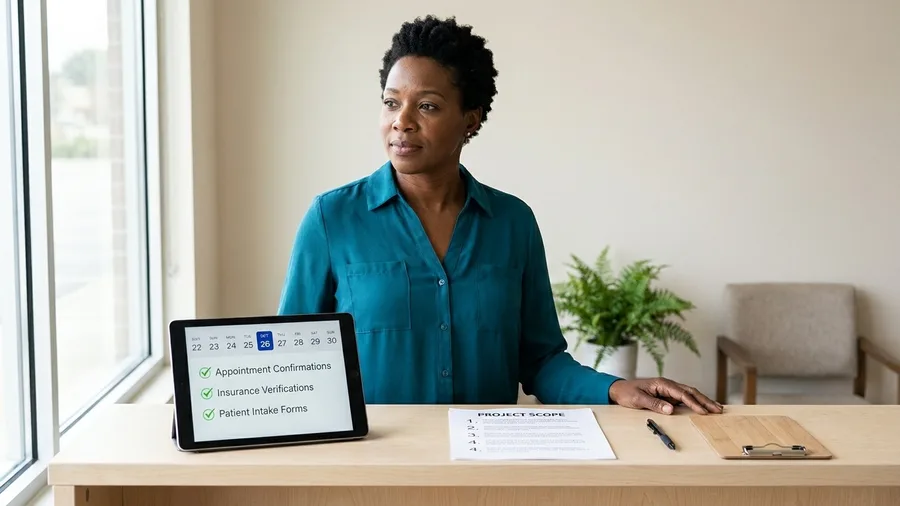
One sale can carry the day, but only if you stop selling widgets and start selling a project. Scope a back-office engagement at $2,000 and finish it across three or four working days – that is $500 to $650 per working day from a single yes. No fourteen buyers a week, no stack of $30 tickets. The chatbot fixes one channel; this bundles the rest of the back office into one fixed-scope piece of work.
The scope that fits in four days is narrow, and staying narrow is the point. Take the intake form and push it into the CRM, set up a reminder sequence, fire a review request after the visit, and build one dashboard the front desk will actually open on a Monday morning. Four deliverables, each one testable by the person who uses it.
What stays out is what closes the deal. No clinical records, no billing systems – the clinic's compliance exposure is untouched, so the approval does not climb through legal. Say that out loud in the meeting. The fastest way to lose a clinic is to ask for access to patient data you do not need.
Clinics say yes because no-shows and phone tag cost them appointment slots they can price. A single missed slot is $150 to $300 of lost revenue, and the front desk staff can tell you how many slip away each week. Ask for that number in the meeting, write it on the whiteboard, and the $2,000 price answers itself.
With no track record, the audit is the credential. Offer a free 20-minute review of one workflow, listen for where the handoffs break, then send a written scope within a day. Take a 50% deposit before you touch anything, and the deposit becomes the proof – the clinic has committed, and you have four days and $1,000 to prove the next $1,000 is worth it.
💡 Tip: Send the scope as a one-page document with a fixed start date and a fixed price. Open-ended proposals from unknown consultants get filed, not signed.
Frequently Asked Questions
How long before I actually make $500 in a day?
In this example, the first paid job lands after 3–6 weeks of sending 10 outreach messages a day. The $500 day comes after you have enough buyers in the pipeline to stack 2–4 jobs, not from your first invoice.
Do I need a portfolio or testimonials to start?
No. Build one sample from public material — a course script for voiceover, a stock photo for staging, a public listing for SEO. Send that sample with 10 specific messages. Your first client's approval becomes the testimonial.
What if a client asks whether a human or AI made the deliverable?
Say it plainly: the voice is synthetic and credited as such, or the copy is drafted with a model and edited by you. The disclosure does not lose the job. Misrepresenting it does.
How much should I spend on tools in the first month?
Keep it under $120. Voiceover needs about $50/mo in tools, staging about $60/mo, and chatbots often run on a platform fee that can be passed through in your hosting charge. Do not buy ten subscriptions before your first client.
Can I run two of these plays at once?
Pick one for the first 60 days. Voiceover and staging each need a production schedule; listing SEO needs a batch schedule; chatbots and sprints need a sales pipeline. Running two before either pays dilutes the 10 messages a day that actually closes work.
The First Paid Week On A $500 Day Play
Ranked by how fast a sample can exist and who you already know, voiceover comes first, a single module in an afternoon. Virtual staging is second, one room in a few hours. Listing SEO third, one rewritten listing. Chatbots fourth, a demo bot plus a business that will take the meeting. The clinic sprint last, because it needs a clinic contact and a written scope before anything moves.
A freelancer with client experience starts with the $1,200 chatbot build: the sale goes to a business that already answers their email. A complete beginner starts with virtual staging at $30 a photo, because the sample takes an afternoon and the buyers are publicly listed vacant properties.
$500 is revenue on a worked day, not day-one profit. Subtract $40 to $120 a month in tools, the revision hours, and the 3 to 6 weeks of 10 unpaid outreach messages a day before the first job lands. The screenshot in the feed never showed the buyer or the job count. This week's version is one sample built and ten messages sent, because the arithmetic only starts on the other side of the first reply.
Send ten messages today
Pick your play, build one sample, and write ten specific messages to named buyers. You can do all of it before the end of the week.