
Four thousand scanned PDFs sit untouched before a model ever sees a token, and that backlog is the job.
A mid-career engineer can spot an LLM application role at $135k to $185k and a RAG role at $130k to $175k on the same team and still stall on which skill to learn first. Titles will not settle it. The skill will, and each one carries its own daily artifact, core tool, salary band, and proof project.
So the choice narrows to a single question: which production dependency does your current strength already reach? A backend engineer who has debugged flaky APIs is a short step from LLM application work. A data analyst already living in messy tables is a short step from AI data engineering.
Carry that match into one small production-grade demo that records its own failure cases or eval results, and you have the artifact that moves a resume. What follows is the shortlist by background, the first project for each skill, and one concrete move to commit to this week.
That demo, not a course certificate, is what a hiring manager reads as evidence you can ship.
Quick Tips Before You Start
Match your strength first
Pick the skill that extends what you already do daily—backend engineers lean toward RAG, platform engineers toward MLOps.
Anchor on one core tool
Choose a single tool per skill, like pgvector for retrieval or Kubernetes for serving, and go deep rather than wide.
Document failure cases
Hiring managers want to see how you handle edge cases, not just a polished demo that only works on the happy path.
Check the salary band
Use the ranges here to target roles that match your experience level and negotiate from a realistic baseline.
Ship one small project
A deployed feature with eval logs beats a notebook every time—build something real and put it in your portfolio.
1. LLM Application Engineering Turns Models Into Products

Most of the week goes into a product feature that happens to call a hosted model, not into training one. A build looks like a support-reply box on a help-center page: pull the five closest articles, assemble them into a prompt, and hand the model a tight instruction set so the answer stays on-topic.
That same feature needs versioning before anything ships. Every prompt edit gets a stored hash, the model name and temperature get logged alongside each draft, and a fixed set of test questions reruns whenever the prompt or model changes. Without that paperwork, nobody can tell a quality regression from a lucky sample.
The failure path is the part teams skip first. When the model's confidence score drops below a set floor, or the response takes more than two seconds, the feature should hand the reader a canned template and a link to the source page instead of a slow guess. Instrumenting that branch is where product feedback lands, not in the model weights.
The toolchain is ordinary application work: Python or TypeScript, a hosted model API, a small vector store for the context passages, and an eval log that records each run. No pretraining, no fine-tuning from scratch, no GPU cluster to babysit.
For a mid-to-senior individual contributor, US base salary for this work sits in the $135k to $185k band, and the interview leans on shipping judgment more than on model theory.
💡 Tip: Build a feature that logs every prompt and response so you can debug regressions before users complain.
| Skill | What you actually do | Core tools | Typical US base salary |
|---|---|---|---|
| LLM Application Engineering | Build features that call model APIs, manage context, and fail gracefully | Python/TypeScript, model APIs, vector store | $135k–$185k |
| RAG and Vector Search | Chunk, embed, and retrieve company documents with citation checks | Pinecone, Weaviate, pgvector, embedding APIs | $130k–$175k |
| AI Evaluation and Safety | Design test sets, red-team prompts, and monitor regressions | Eval frameworks, prompt logs, guardrails | $140k–$190k |
| MLOps and AI Platform | Serve, scale, and monitor models with rollback paths | Kubernetes, Docker, MLflow, cloud AI services | $145k–$195k |
| AI Data Engineering | Ingest, clean, deduplicate, and label unstructured data | Spark, dbt, object storage, labeling platforms | $125k–$170k |
| AI Agents and Workflow Automation | Build multi-step tool-calling systems with state and permissions | Agent frameworks, workflow engines, structured output schemas | $135k–$180k |
| AI Product Management | Translate business problems into measurable AI features | Product analytics, eval dashboards, cost models | $150k–$200k |
| AI Security and Governance | Threat-model AI systems and document controls for audits | Security scanners, policy engines, DLP, governance templates | $140k–$195k |
2. RAG Skills Fix What The Model Does Not Know

Once a product feature has to answer from private company documents, retrieval becomes the bottleneck, and that is the dependency a model API cannot fill in for you.
A model trained last year has never read this year's HR policy or the current pricing sheet, and no prompt trick fixes that. The retrieval layer does: split each PDF into chunks of 300 to 800 tokens, embed them with an embedding API, and store the vectors in a database that returns nearest neighbors fast. Pinecone, Weaviate, and pgvector all cover the job; the tradeoff is managed service versus something your backend team already runs.
Chunking is where most of the quality gets won or lost. Cut on section headers, keep a 50-token overlap so a sentence spanning two chunks still reads cleanly, and test the chunk size against real questions rather than a hunch.
Take an internal policy assistant: 400 pages of HR PDFs go into pgvector, the top 20 candidates from the vector search get reranked by a cross-encoder, and the answer cites the source paragraph beside it so a reader can check the claim. Citation checks then catch the silent failure, where the model answers correctly but points at the wrong paragraph.
US base salary for these roles runs $130k to $175k. Backend and data engineers tend to slide in fastest, because debugging a relevance score feels like debugging any other metric in a pipeline.
The portfolio proof is a retrieval demo that records the chunking choices, the reranker, and the citation checks on five questions the system got wrong.
RAG failure severity: from annoying to business-ending
How bad different retrieval problems get in production
- Irrelevant chunk retrieved: Answer is vague but harmless; user retries.
- Missing citation: Answer sounds confident but can't be verified; trust erodes.
- Outdated document returned: Policy answer is wrong; support tickets pile up.
- Confidential document leaked: Regulated data exposed; legal and compliance involved.
Rank your own RAG demo against these four failure points before you show it to a hiring manager.
3. Evaluation And Safety Engineering Keeps AI Trustworthy

The evaluation and safety engineer produces the evidence that an AI feature behaves well, both at launch and after the next prompt or model change. Grounded answers create a measurement problem of their own: a citation can point at the wrong paragraph and look correct at a glance, so someone has to define what counts as right.
The day is spent building test sets, running red-team prompts, tuning guardrails, and watching regressions. A release gate for a support assistant might hold 200 fixed test prompts, 30 adversarial cases for data leakage and prompt injection, and a policy filter that blocks regulated advice. A model upgrade goes out only when the dashboard shows no drop against that set.
The tooling is unglamorous and entirely reusable: eval frameworks to score outputs, prompt logs to reconstruct what the model saw, a human review queue for borderline answers, and filters that catch forbidden content.
US base salary for this work is $140k to $190k, which signals how much companies pay for someone who can turn a vague worry into a pass or fail line. QA, ML, and security engineers fit the role fastest, and a fair share of the work is writing policy-like rules in plain language.
The portfolio proof is an eval harness that runs the cases, records the failing ones, shows the guardrail decisions, and closes with a regression report.
💡 Tip: Start with 50 real user prompts that previously caused problems, then grow the test set from there.
4. MLOps And Platform Engineering Gets AI Into Production
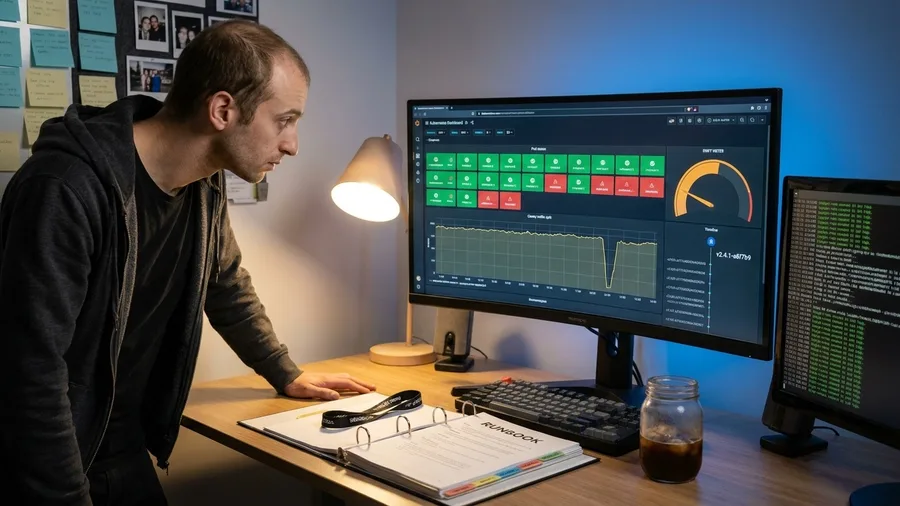
Shipping an AI prototype to production means owning the serving, scaling, and rollback path so that every eval gate actually fires on live traffic.
The work is production reliability for model workloads: getting endpoints up, scaling them under load, watching drift, and pulling a bad model version back before customers notice. It is not architecture research and not prompt work. A team can spend weeks on a 200-prompt regression suite and lose all of it if nobody can redeploy the prior model version at 2 a.m. when error rates climb.
The day-to-day list is short and blunt: model serving, GPU capacity planning, CI/CD for model artifacts, and drift monitoring wired to alerts. The tool stack that anchors it is Kubernetes and Docker for the runtime, MLflow or Weights & Biases for experiment and model tracking, and a cloud AI service for managed endpoints when building from scratch is not the point.
Typical US base salary: $145k-$195k for mid-to-senior individual contributors.
A concrete example makes the shape clear. A model endpoint runs on Kubernetes with autoscaling tied to request queue depth, ships through a canary deploy that sends 5 percent of traffic to the new version first, and exposes latency and drift dashboards. A fixed 300-case eval set runs on every deploy; if error rate rises more than two points, the rollback path fires automatically and pages the on-call engineer with the prior version hash.
This is a direct translation for platform, DevOps, and backend engineers who have already run production infrastructure. If you have handled a canary release, a capacity incident, or a rollback under pressure with any service, you are doing this skill already; the only new part is that the artifact on the other side of the deploy is a model with its own failure modes.
The proof project is a served model with a deployment config in the repo, a monitoring dashboard that shows real request latency and drift, and a written rollback procedure you have actually executed once and recorded. A job listing will ask about Kubernetes and MLflow; the portfolio piece that answers it is the runbook plus the green canary logs.
⚙️ From prototype to production: the MLOps rollout path
Pin the eval gate first
Write the 300-case eval set and the two-point error threshold before the first Docker build. The gate defines done.
Set queue-depth autoscaling
Scale on request queue depth, not CPU. CPU stays flat while requests pile up behind a slow tokenizer.
Start canary at 5 percent
Hold 5 percent for 30 minutes minimum. Below 5 percent, a two-point error shift will not show up in the sample.
Alert on drift, not just errors
Latency and error alerts fire on the canary; drift alerts watch input distribution and fire on the full fleet.
Record the rollback run
Execute the revert once on staging and save the terminal output with the prior version hash. Untested runbooks fail at 2 a.m.
5. AI Data Engineering Makes Unstructured Data Usable

AI projects stall because the data is a mess: 4,000 scanned PDFs, images with no metadata, and logs split across three systems, all before a model ever sees them.
A well-served endpoint and a clean retrieval index are only as good as the data feeding them. Half the stalled projects you hear about failed in the ingestion layer, not the model layer.
The work is ingestion, cleaning, labeling, deduplication, and data quality checks that turn raw files into clean training and retrieval sets. It is Spark jobs, dbt models, object storage buckets, labeling platforms, and pipeline orchestrators with retry logic and alerting.
Typical US base salary band: $125k-$170k. Data engineers and analysts who trust pipelines more than prompts fit this best.
A concrete example: a document pipeline that ingests scanned PDFs from an S3 bucket, runs OCR, deduplicates near-identical files by content hash and fuzzy similarity, labels sensitive fields for redaction, and blocks low-quality chunks from entering the vector index.
If you would rather fix a flaky pipeline than tune a model, this is your entry point. Portfolio proof is a pipeline that runs end to end, shows data-quality checks firing, and includes a before/after comparison of a retrieval set built from dirty versus cleaned data.
⚠️ COMMON MISTAKE
Don't skip the data-quality gate
Most RAG projects fail because teams embed everything without deduplication or quality checks; invest early in a pipeline that blocks bad chunks before they reach the index.
6. AI Agent Builders Automate Multi-Step Workflows

What separates a useful agent from a broken demo is state, retries, permissions, and a clean path to human escalation.
An agent that calls three tools in a row and works on the happy path is a weekend project. The moment it runs on messy production data across systems it did not build, the demo collapses on step two or three: a tool returns a rate-limit error, a partial write leaves a record in a half-finished state, or a permissions check fails silently and the agent keeps going on stale inputs. Clean data pipelines and controlled tool access are the foundation; the agent has to act on both without compounding one bad input into a cascade.
The daily work is tool calling, state management, idempotent retries, permission checks, and human handoff. The core tool anchors it: an agent framework or workflow engine, plus APIs and a structured output schema that forces the model's tool arguments through a validated shape before anything executes.
Typical US base salary: $135k-$180k for mid-to-senior individual contributors.
Walk through a refund agent and the difference from a demo is visible line by line. It reads the order state from an orders API, calls the payment provider to issue the refund, checks a refund-limit policy before committing, retries idempotently when the payment call times out so a customer is never double-refunded, and hands the whole case to a human when the amount exceeds the configured rule. Every state transition is logged. A crash at step three leaves the order recoverable, not stuck half-refunded.
Backend engineers who already think in distributed-systems failure modes are the natural fit. If you have debugged a retry storm, an at-least-once delivery bug, or a distributed transaction that left two systems out of sync, you already hold the mental model the job requires. The only shift is that one of the services in the chain is now a model whose tool call you did not write in advance.
The portfolio proof is a multi-step workflow with published tool schemas, a state diagram showing every transition, permission checks that actually reject an out-of-scope call, and escalation logs that show the moment a case left the agent's hands for a human queue. The transition argument is not the framework you used; it is the failure handling you put around it.
💡 Tip: Design every tool call to be idempotent so retries don't double-charge or double-send.
Agent terms, plainly defined
7. AI Product Managers Connect Use Cases To ROI

An AI product manager translates a business problem into an AI feature that ships, hits a measurable threshold, and costs less to run than the value it returns. That is a narrower job than roadmap management.
Once an agent is doing real work in a support queue or a refund flow, the cost and risk questions land on someone's desk. Which of the twenty possible use cases is worth the model spend and the compliance exposure? Answering that is the product layer.
The daily work splits into four habits: use-case discovery with the teams who own the workflow, success metrics defined before any prompt is written, hard constraints on what the model may and may not do, and build-versus-buy calls on every vendor demo. Tools: product analytics, an eval dashboard, a prompt prototyping scratchpad, and a cost model that turns token counts into dollars per case.
Typical US base salary band: $150k-$200k. The fit is someone technical enough to read an eval report and financially literate enough to defend a per-case cost in a budget meeting.
Take a claims-triage feature. The PM sets the accuracy threshold at, say, 92 percent before engineering starts, then calculates that the model call runs about $0.04 per claim and the human review of a flagged claim costs $6.50, so the accuracy threshold is a cost lever, not a quality preference.
That same calculation decides build versus buy: a vendor API at $0.02 per claim against an in-house RAG build at $30k of engineering time and $0.05 per claim. The eval dashboard, not the demo, becomes the launch metric.
If you can sit in one conversation holding an engineering constraint on one side and a P&L line on the other, this is your transition.
Portfolio proof is a single page: eval criteria, the cost model with its numbers, and the build-versus-buy decision with the reasoning that produced it.
AI PM versus traditional PM: what changes
Traditional PM
- Roadmap built from user interviews and revenue targets
- Success is adoption, retention, and booked revenue
- Trade-offs are sprint capacity and feature scope
- Ship when the feature is complete and QA-signed
AI PM
- Roadmap waits on model capability and clean training data
- Success is eval score, cost per case, and user trust
- Trade-offs are accuracy, latency, and token spend
- Ship when eval clears threshold and guardrails cover the edge cases
8. AI Security And Governance Keeps Systems Compliant

AI security and governance work is threat-modeling, documenting, and auditing a model-backed system until you can defend it to a customer audit and a regulator in the same quarter. The moment a product team puts AI on customer data or a regulated decision like credit, insurance, or medical triage, that obligation lands on someone.
The core work breaks into five jobs: threat modeling the AI surface, locking down access control, setting data retention rules, writing model documentation, and keeping an audit trail that ties every model version to its data. The tooling matches: security scanners, a policy engine, data loss prevention on the logging path, and governance templates that map controls to whichever framework legal names.
Typical US base salary sits at $140k-$195k. The fit is a security, risk, or compliance professional willing to learn how a model actually behaves, because a threat model written by someone who does not know what a prompt injection is will miss the whole attack surface.
Picture the customer-support assistant. The retrieval index gets role-based access so a tier-1 agent cannot pull the executive comp PDF. PII is redacted at the logging layer before any transcript hits storage. A bank of prompt-injection tests tries to talk the system out of its guardrails, and each result is logged.
Then the audit trail: model version 4.2, its training and retrieval sources, and every policy exception signed off with a date.
If writing controls and assembling evidence for an auditor is already your day job, this is the translation, not a career change. The portfolio proof is a threat model for one AI system, a policy engine rule set in code, and a sample audit trail that links a model version to its sources and exceptions.
💡 Tip: Redact PII before logging any prompt or response—auditors will ask for it.
Frequently Asked Questions
Do I need a master's degree to get an AI job?
No. Most of the skills on this list are learned through building and shipping projects. A strong portfolio with production-grade demos and documented failure cases often carries more weight than a degree, especially for engineering roles.
Which skill is easiest to transition into from a software engineering background?
LLM application engineering or RAG are the most direct transitions because they build on API integration, backend debugging, and product shipping skills you already use. You can prove competence with a deployed feature and eval logs in a few weeks.
How long does it take to become job-ready in one of these skills?
Focused study plus one solid portfolio project usually takes two to four months if you already have adjacent experience. The key is to build something real, instrument it, and document what breaks—that's what hiring managers evaluate.
Are these salary bands realistic for remote roles?
The bands reflect typical US base salaries for mid-to-senior individual contributors. Remote roles may adjust based on location, but companies hiring for these skills generally benchmark against national ranges. Use the band as a negotiation starting point.
What if I'm a data analyst without engineering experience?
AI data engineering is the closest fit—it values pipeline reliability and data quality over model tuning. Start by building a document-processing pipeline that demonstrates deduplication and quality checks, then show how cleaner data improves retrieval.
Sort yourself into a starting point and build one demo
Software engineers should start with LLM application engineering, RAG, AI agents, or MLOps and platform work. Data analysts should start with AI data engineering, product managers with AI product management, and security or compliance people with evaluation and safety or AI security and governance.
The first move is the same for all eight: pick one skill, build a small production-grade demo with its core tool, document the failure cases or the evaluation, and put it in a portfolio. The listings still overlap. The portfolio artifact that holds up under failure is what separates you.
Pick the skill nearest your existing edge, and let the demo, not the course list, argue for the transition. Then rebuild the numbers that started this: your band, your tool, your first project.
Pick your skill and start building
Choose the one that matches your current role, then open a new project and build the demo described in that section. Document what breaks—that's your portfolio proof.