
Learn this one question and you can grade any robot video in about ten seconds: what does the machine cost per hour or per mile, and who finishes the last ten percent of the job? The squat six-wheeled cooler box crossing a campus at 4 mph for a $1.99 flat fee answers both. It is already rolling an ordinary sidewalk near you.
Most of what scrolls past your thumb is a demo reel. The working machines are narrower than the headlines, leased by the month, and shadowed by people who clear the last ten percent of every job.
Ten examples in ordinary American places do the sorting for you, from the campus sidewalk and the warehouse aisle to the coffee kiosk, the hospital corridor, the lawn, the street, the field, the parking lot and the car plant. Each one comes with a price, a speed, and an honest note on what still needs a person.
Automation, it turns out, is real but narrow: specific costs, specific speeds, and a human chain always finishing what the machine starts. Once you know to ask who does the last ten percent and what the robot costs per hour, the next video tells you where things actually stand.
Quick Tips Before You Start
Ask for the number
A robot without a price per hour, per mile or per month is still a demo, so skip the video until you find one.
Find the human in the loop
Every working robot has a person behind it — a restocker, a remote operator, a nurse checking the tote. Look for them.
Check the map
Self-driving taxis and sidewalk bots run only inside mapped zones, so the job does not exist outside that boundary.
Ignore the years
Warehouse shelf robots have been paid for over a decade. Old tech at huge scale is the real story, not the new one.
Compare against the alternative
A robot competes with a wage plus turnover, not with a clean theoretical price. A $500-a-month tray robot beats a shift nobody can fill.
1. Sidewalk bots delivering lunch across campus
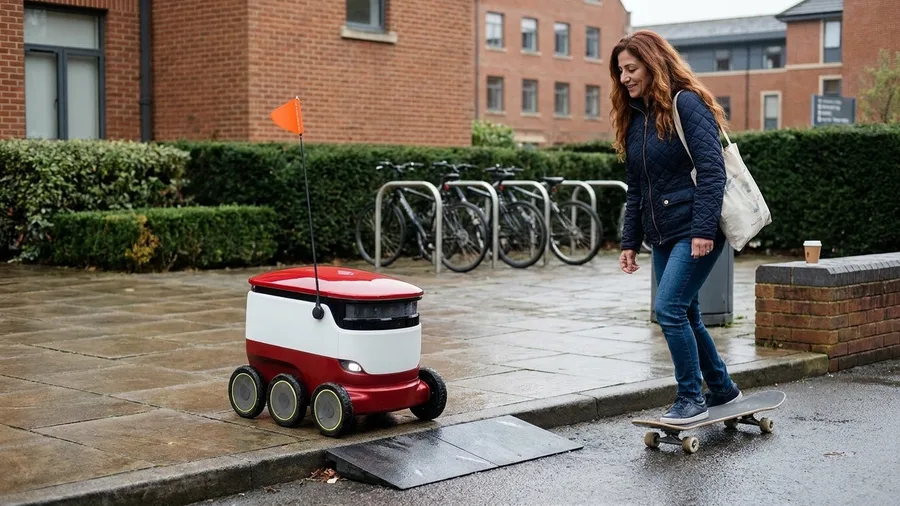
Those squat cooler boxes with six wheels and a flag on a stalk are not a dead pilot. They are running lunch right now on dozens of US campuses and a handful of city neighborhoods, and they charge real money for it.
A typical campus fleet puts about 200 of them to work inside a 3-mile radius, which is small enough to learn every sidewalk and loading dock by heart. The bot costs a flat $1.99. Order the same burrito through a human delivery app on that campus and you pay $4.99 plus tip, so the price gap is the pitch, printed on the screen before you confirm.
The box tops out at 4 mph, roughly a brisk walk, and it is programmed to give way to anyone on foot. Watch one at a curb and you see the limit: it stops, waits for a ramp or a remote operator to nudge it through, then rolls on.
At a locked dorm door it simply halts and pings your phone.
Behind the fleet sits the part the videos cut out. One remote operator watches several bots at once, answering the questions the machines cannot, which means every cheerful cooler has a person on the other end of a screen.
The geography explains the spread. These bots thrive where the sidewalks are wide and predictable, college campuses and master-planned suburbs, and stall in a dense downtown where a curb cut is a coin flip.
💡 Tip: If you want to see one up close, hang around a campus library around noon on a weekday — that is peak burrito traffic.
| Robot | Cost to buy or run | Speed or coverage | What a human still does |
|---|---|---|---|
| Sidewalk delivery bot | $1.99 flat fee | 4 mph, 3-mile campus radius | Waits on a ramp; a remote operator watches several at once |
| Warehouse shelf robot | Site-scale lease | 1,200 per fulfillment site | Picks the item from the shelving unit |
| Coffee kiosk arm | Price of the latte: $4.25 | 100 cups an hour at peak | Restocks beans, milk and cups each shift |
| Restaurant food runner | $18,000 to buy or $500 a month | 3 mph, four trays | Seats, takes orders, refills, handles allergies |
| Hospital pharmacy bot | $1,100 a month lease | 35 deliveries a day | Nurse verifies the locked tote at the door |
| Robot mower | $1,800 | 0.4 acre, 1.5 to 4 inch cut | Edges, leaves, spring cleanup |
| Driverless taxi | $2.50 base plus $1.10 a mile | 60-square-mile service area | Remote assistance answers the car's questions |
| Weeding rig | $150 an acre | 20 acres a day | Marks and rechecks the fields the model mistook |
| Patrol robot | About $9 an hour | 3 mph, 420 lb, fixed route | Monitoring center and a responder who drives out |
| Humanoid in a car plant | About $30,000 a year leased | Two shifts a day on tote moving | Technician on site; someone liable when it drops a load |
2. Warehouse shelf robots that walk the aisles
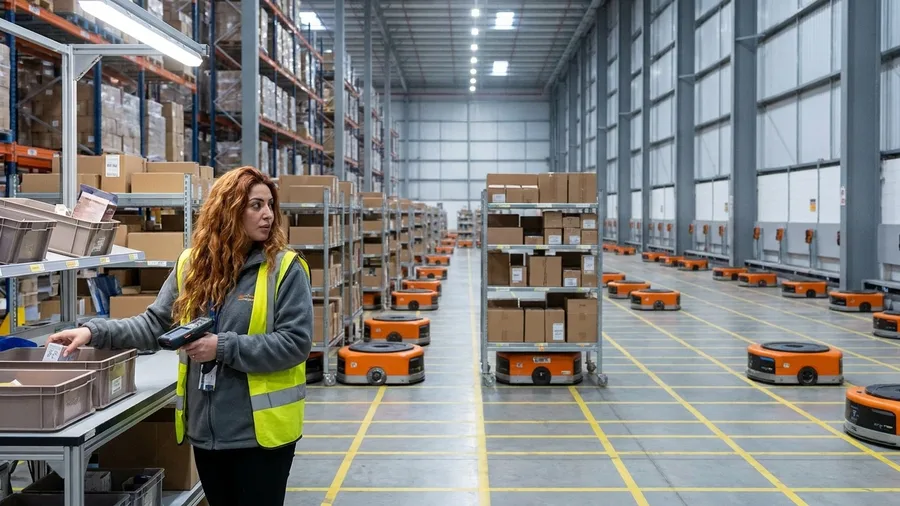
Strip the sidewalk out of the delivery problem and the same idea survives: a machine hauls the payload, a person handles the final touch. On the floor of a fulfillment center, it looks nothing like a cooler box. Flat, low orange platforms glide under entire shelving units and lift them off the ground, whole racks swaying an inch above the concrete.
The bots ferry that shelving to one fixed station where a picker stands with a handheld scanner. This is the least photographed robot in the country and the one you are most likely to have bought something from. A single large site runs about 1,200 of these platforms at once.
The human still plucks the item from the bin and drops it in the tote.
What changes is foot traffic. The picker used to burn roughly nine miles a shift walking to the goods; because the goods now travel, that figure lands near one mile, and the hours that walking ate go into grabbing items and reading labels. The picker is not replaced. The picker stops commuting.
The building itself got rebuilt around the machines. The floor sits clear of debris the bots would jam on, charging spots line the walls, and the whole warehouse is laid out on a grid the platforms run along.
💡 Tip: When evaluating any warehouse automation claim, ask how many robots per site and what the picker's walk was before. Those two numbers tell the truth.
⚠️ COMMON MISTAKE
Do not judge a robot by its demo reel
The most convincing-looking machines are usually the least deployed. Shelf robots, which look boring, run 1,200 per site; the humanoid folding laundry in a viral clip is still in pilot. Check the deployed count before you check the video.
3. A robot barista in a 20-square-foot kiosk
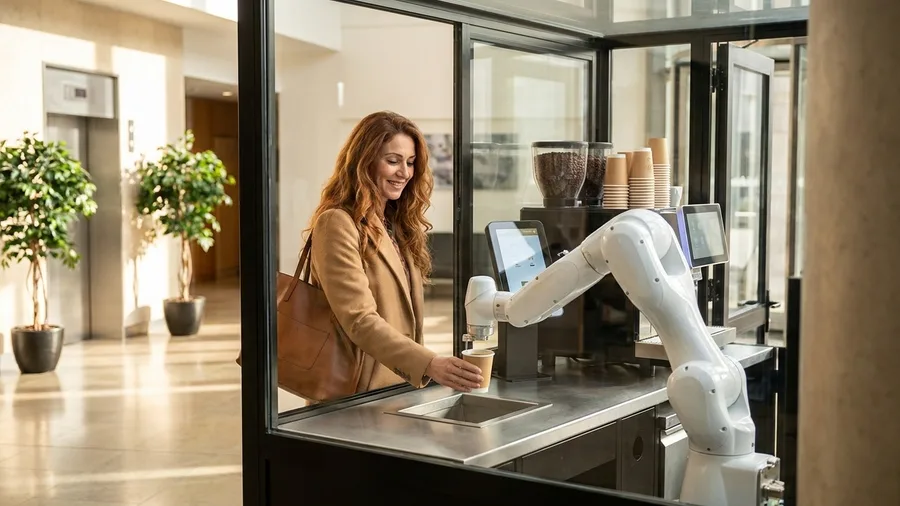
A warehouse robot needs a building poured around its grid. Shrink that same fixed automation down to 20 square feet, drop it in a lobby, and you get the arm-in-a-box that hands you coffee through a slot.
At peak the kiosk pours about 100 cups an hour, and the latte costs $4.25. The arm pulls identical shots on every pass, which is the whole point: not better coffee, just the same coffee every time, with no line snaking toward the door at 8 a.m.
You order on a touchscreen and never say a word to anyone.
One person still works each shift. A restocker tops up the beans, the milk and the cup stack, and that job did not vanish, it just moved to the back of the box where the camera does not reach.
The limits are hard-edged. No custom orders, no oat-milk-versus-whole conversation, no asking how your morning is going. And when a cup tips over inside the case, the fix is a technician with a key, not a barista with a rag.
The machine wins on repeatability and throughput, and it wins only where the menu is short enough to fit inside a box.
Robot Barista — At a Glance
📊 Break-even volume
~254 cups/day
📐 Footprint
20 sq ft kiosk
🕗 Restock window
Between 8 a.m. peaks
🧽 Staff still needed for
Filling and cleaning
🔑 When a cup tips
Machine halts until key
The hidden job
Restocker also clears jams and wipes the slot — roughly 15 minutes per hour of downtime.
4. Restaurant food runners that never take a tip
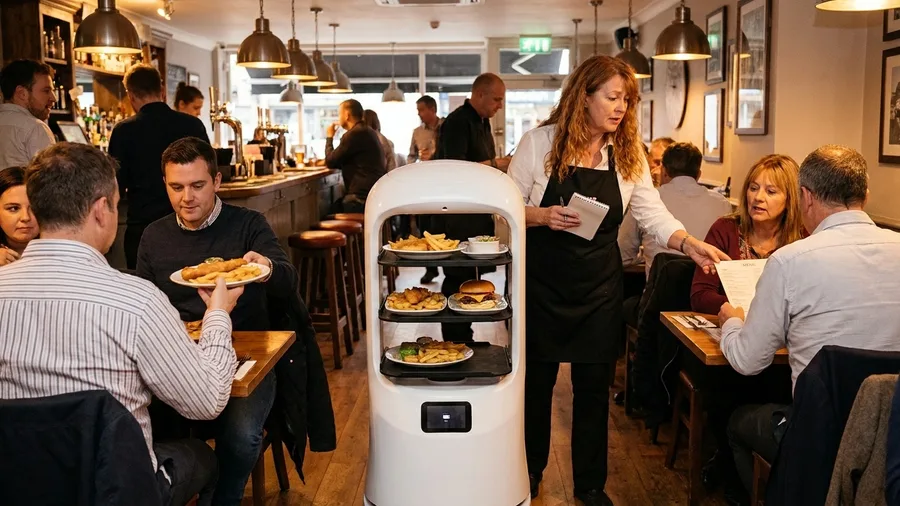
The kitchen doors swing, and the plate comes out on a tray held by something that will never ask if you want more water. Across a growing number of casual restaurants, tray-carrying food runners shuttle plates from the kitchen to the tables: $18,000 to buy one, or about $500 a month on a lease, carrying four loaded trays at a walking 3 mph pace.
Watch it move and the limit is obvious in the first minute.
It runs a mapped route through the dining room, threads the gap between the bar stools and the corner four-top, stops, and waits for a guest to lift the plate. The person whose job it took over still seats you, jots the order, refills the water, and fields the question about what is in the sauce. If you tell this robot about a nut allergy, nothing happens. That's the tell.
Operators who sign the lease are not doing the arithmetic you would expect – they are not running the robot against a wage and finding it cheaper. They buy because they cannot fill the runner shifts at all: the applicant pool is thin and the turnover is punishing. So this is a staffing fix wearing a cost-benefit's clothes.
The friction is physical and it shows up on a Friday night. A four-tray runner needs aisle clearance a busy dining room does not always have, guests step around it on their way back from the restroom, and somebody has to map the floor plan before it can serve a single order. Every new table arrangement means the route gets redrawn.
And the check still comes to your table with a human hand on it, because the last ten percent of waiting tables – the refill, the apology, the read of the room – has no tray on it.
💡 Tip: A robot runner's ROI depends entirely on your local runner wage. At $500 a month against 40 hours a week at $15 an hour, the robot is the cheaper line — until you count the person still seating guests.
The Last Ten Percent, Stacked
What a robot handles versus what a person still owns, in order of how hard it is to automate
Based on the ten robots profiled in this article.
5. Hospital robots running the pharmacy route
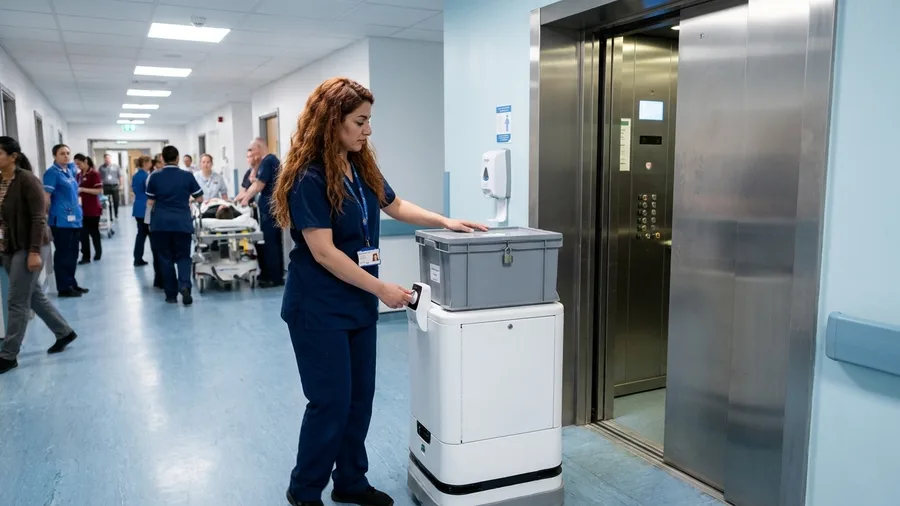
Medication can wait exactly as long as the nurse's feet take to walk it down the corridor, and not one minute longer – which is why the same logic that moves plates in a restaurant becomes urgent the moment a hospital gets hold of it. Boxy delivery robots roll locked medication totes between the pharmacy and the nursing units, leased at $1,100 a month, running about 35 deliveries a day.
That lease is one of the few on this list where the robot is clearly cheaper than the person whose steps it saves.
The robot never opens the tote. It arrives, the nurse taps a badge on the lock, and the verification – the right drug, the right dose, the right patient – happens in human hands. The machine carries; the person confirms. Every dose still passes a person.
The engineering that makes this work is the part nobody films: the robot calls the elevator itself and waits for the doors to cycle, and it holds for fire-door clearances without a human sprinting ahead to press the button.
What the hospital is actually buying is the hour. A nurse gets roughly an hour back per shift that used to go to walking and waiting, and an hour of a nurse's attention is the real product, not the tote that arrived on time.
The catch sits where the building is busiest. A hospital corridor at shift change is the toughest environment on this list – gurneys, visitors, rubber-soled traffic in both directions – and that's where the route has to hold every day.
6. A robot mower for a quarter-acre lawn
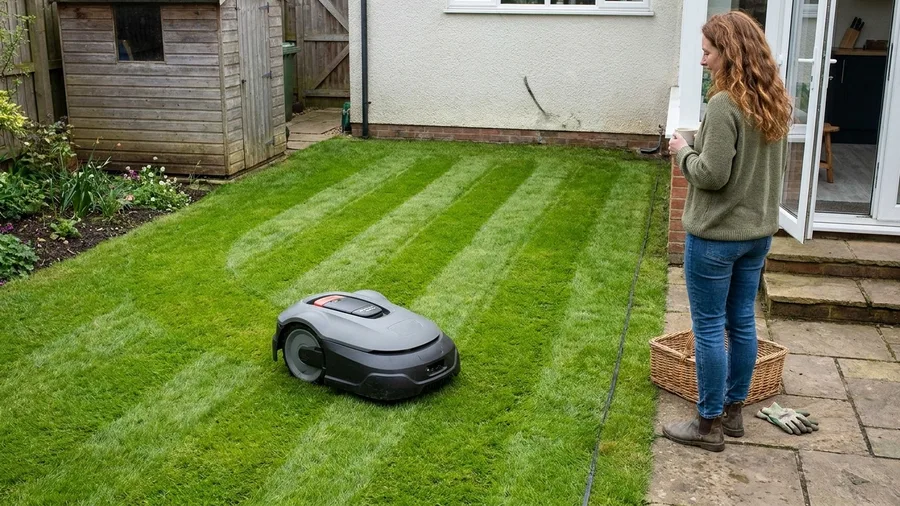
A robot that undercuts a nurse's shift and a robot that trims your grass answer different questions. The one you can drive home from the store this afternoon costs $1,800, covers 0.4 acre on a single charge, and sets its own perimeter by GPS while you watch from the porch.
Four hundredths under the quarter-acre most people are mowing, and the blade deck adjusts from 1.5 to 4 inches so you match the height you already keep.
The blades stop dead the instant the unit lifts off the ground, which matters more than any spec sheet when a kid runs into the yard.
GPS draws the boundary in the app, but a yard broken up by planting beds, a shed and deep shade is still cheaper served by a buried boundary wire. The satellite fence drifts under tree cover; the wire does not.
Where it stops: steep grades, leaf cover, edging along the walk, and the shaggy first cut of an overgrown spring lawn. A person still handles those.
So the payback here is not money. It is the two weekend hours back in your hands, and a lawn that comes out striped rather than manicured.
💡 Tip: Set the mower to run every other day at a higher cut height rather than weekly at a short one — the grass looks healthier and the robot finishes faster.
Robot Mower: Worth It or Not?
Worth it
- The mower pays for itself in about 90 weekend hours.
- Set the deck to 1.5 inches in spring, 4 inches by July.
- Buried wire costs roughly $100 per 100 feet installed.
- A 0.4-acre yard clears in one charge with 20% left.
Skip it
- Slopes over 25 degrees defeat the traction; hire it out.
- Leaf cover clogs the deck every 10 minutes in October.
- GPS drift hits 3 feet under dense canopy.
- An overgrown spring lawn needs a 3-inch first cut by hand.
7. Self-driving taxis you can hail tonight
A robot mower trims a private lawn on a timer. A driverless taxi does the harder version of that trade on public pavement, and the customer sets the clock.
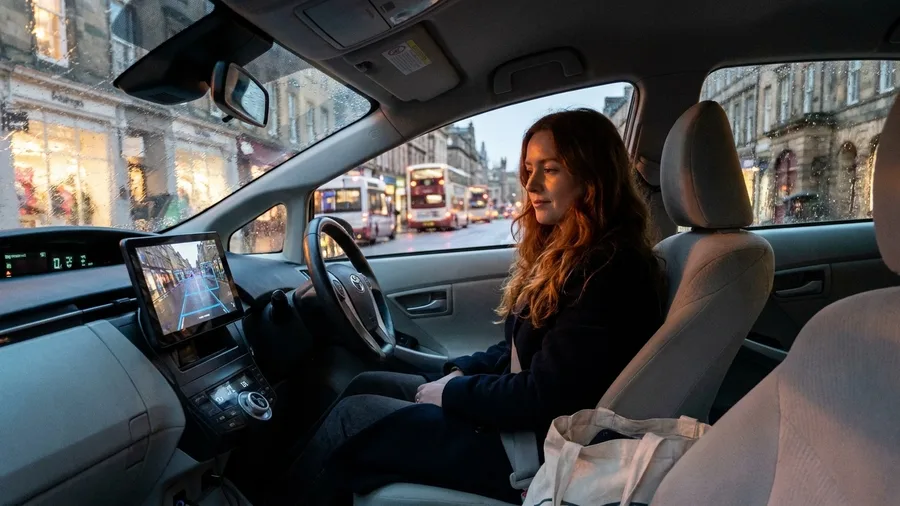
Paid, no-driver fares are running right now in a short list of American metros, and the ride itself is almost boring. You open the app, a car with nobody in the front seat rolls to the curb in about eight minutes, and you climb into the back.
The fare math is plain: $2.50 to start, then $1.10 for every mile. Cheaper than a surge-priced human ride at 2 a.m., and there is no tip screen at the end.
The service area is the part people miss. Sixty square miles sounds huge until you draw it, and it is a mapped core with hard edges, so a trip that crosses out of it simply cannot be booked. The airport run may still put a person behind the wheel.
Watch the car think. It creeps through an unprotected left turn like a new driver counting to three, then takes the highway on-ramp at full speed with total confidence. A screen on the dash shows the lane lines and the pedestrians as the car sees them, and that display is the clearest window into the machine's nerve.
Somewhere off-site, a person is watching. When the car meets a construction reroute or a lane blocked by a delivery truck, a remote assistant answers the question and gives it a path, then goes back to the next car. They are not steering. They are the ones who close the loop when the map and the street disagree.
💡 PRO TIP
Watch the car's screen, not the road
The back-seat display shows exactly what the car sees. Watch it on the first ride and you will understand rapidly why the car hesitates at certain corners — usually a cyclist or a construction barrier it is tracking.
8. Weeding rigs that hoe 20 acres a day
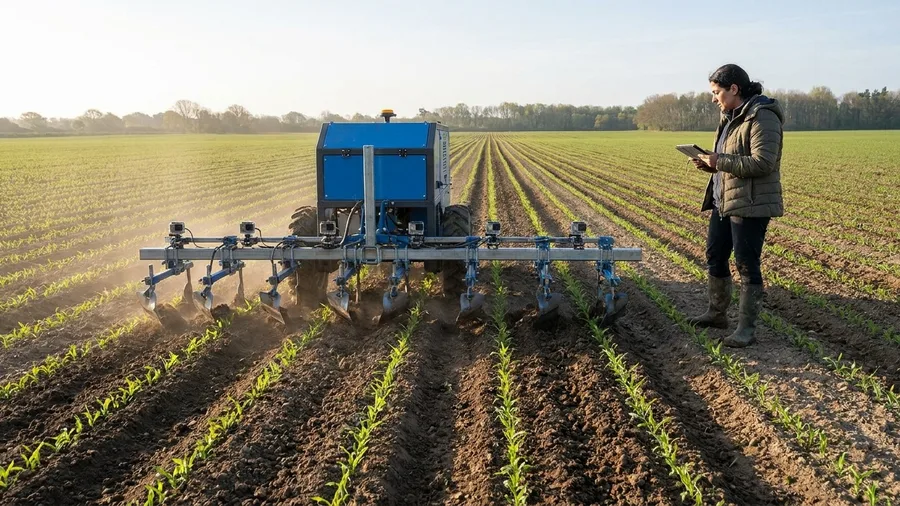
Way past the warehouse floor, out where the rows run to the tree line, the machines are working. A camera-guided cultivator moves down a crop row and cuts weeds out of the ground with steel, no sprayer behind it.
The rate card is per acre, not per hour or per ride. Figure $150 an acre, and the rig covers roughly 20 acres in a working day, running 12 hours in daylight or swapping to a headlight setup after dark.
Twelve cameras ride the toolbar, feeding a trained model that decides, blade by blade, which green thing is a weed and which is the crop. The confusion case is brutal and specific: crops whose seedlings look like the weeds beside them. Get that wrong and the machine hoes your money into the dirt.
Compare the $150 against a herbicide pass plus the chemical itself, not against the sprayer alone. That is the honest line, and it is why growers with resistant weeds and a thin labor pool are the ones calling.
Nobody buys one of these for a whole farm on day one. It goes on one field, one crop, one season, because a model that misreads a seedling costs a real yield, and a farmer will not bet the year on a first draft.
By the Numbers
Four figures from this list that reframe how close the robot future really is
9. Patrol robots circling the mall parking lot
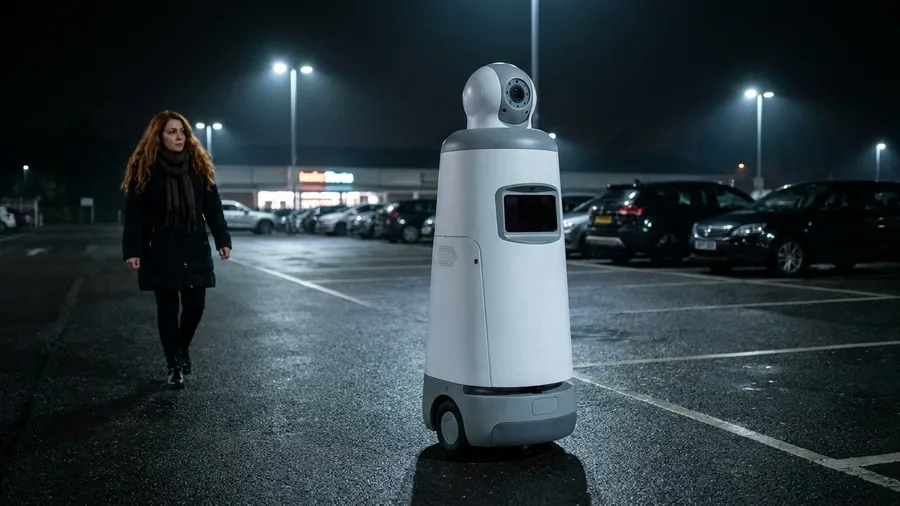
The field rigs knock off at dusk. The security robot is just clocking in, and it will circle the same lot until sunrise.
What rolls past your parked car is a 420-pound pillar on wheels, 3 mph, with a camera head and a thermal sensor, following a route stored in its memory and repeating it all night. Call it $9 an hour.
It is not a guard. A door it cannot open, a curb it cannot climb, a person it cannot chase, and people have walked around it like a traffic cone. Its documented failures are the kind that make a property manager wince.
The real operation sits behind the camera feed. A monitoring center watches the alerts, and when something trips, a human responder drives out to the lot. The robot is the tripwire; the person in the truck is the response.
What it actually sells is a lit, recorded, predictable presence in a lot that had none, a deterrent and a stack of evidence for the morning report. That is a real product at $9 an hour, as long as everyone involved understands it is watching, not intervening.
10. Humanoids moving totes in car plants
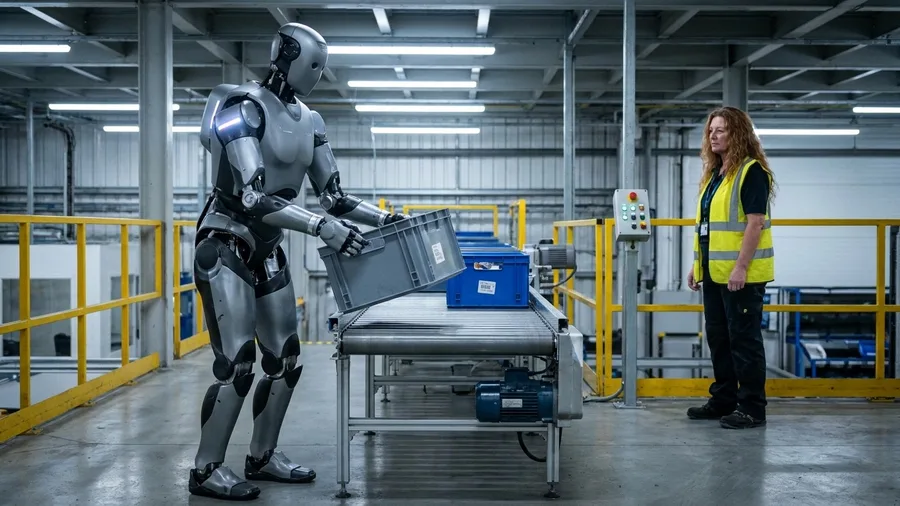
The tallest machine on this list does the smallest job. A 5-foot-9 humanoid stands at the end of a conveyor line in a car plant, grips a plastic tote with two arms, lifts its 65-lb payload, turns, and sets it down on another line. Then it does it again for the rest of the shift, two shifts a day.
That is the paid work: pick-and-place on tote moving. No folding, no walking across a lawn to retrieve a dropped glove.
The lease runs roughly $30,000 a year. Why build it human-shaped at all? Because the plant is already shaped for people. Aisles, stairs, doorways, handrails, the gap between a conveyor and a wall – all cut to human dimensions decades ago, so a machine that fits those dimensions needs no factory rebuild. A wheeled platform would demand a rebuilt floor. A humanoid walks in and starts.
The demo reel and the paid shift are different jobs, and the distance between them is the story. In videos the humanoid walks a hallway, folds a towel, waves at a crowd of engineers. On the clock it moves totes between conveyor lines for hours. Walking is the hard engineering; tote moving is the invoice.
Watch two lines in the lease before you believe a humanoid video. Does the monthly number cover a technician on site, or is that a separate contract? And who is liable when a 65-lb tote slips out of two grippers and lands on a worker's foot? A camera on wheels at least fails into a parked position. A torso on legs fails downward, near people.
Every other machine here has a settled answer to that question. The humanoid's is still being written, which is why its video is the one most likely to be a demo and least likely to be a line item.
💡 Tip: A $30,000-a-year humanoid lease sounds cheap until you price the technician, the insurance and the floor space. Ask for the all-in figure.
Frequently Asked Questions
Are delivery robots on sidewalks actually allowed everywhere?
No. They run on dozens of college campuses and in some master-planned suburbs with wide, unobstructed sidewalks. Dense downtowns with narrow sidewalks and heavy foot traffic are much harder to operate in, which is why you rarely see them there.
How much does a driverless taxi cost compared to a regular rideshare?
In the metros where they operate, the fare runs $2.50 base plus $1.10 a mile, with an average wait of about 8 minutes. That is often competitive with a human-driven rideshare, but the service only works inside a mapped 60-square-mile core.
Do I need a buried boundary wire for a robot mower, or does GPS work?
GPS boundary works, but a buried wire is often the cheaper and more reliable install for a yard cut up by beds, paths and shade. If your yard is open and flat, GPS is fine; if it is complicated, the wire is worth it.
Can a robot really replace a restaurant server?
No. A tray-carrying robot moves plates from kitchen to table, but a person still seats guests, takes orders, refills drinks and handles allergy questions. Operators buy the robot because they cannot fill runner shifts, not because it replaces the server.
Are warehouse shelf robots a new technology?
They are at least a decade old. A fulfillment site can run about 1,200 of them, and a picker's walk drops from roughly 9 miles a shift to 1. The surprising part is the scale, not the age.
Ten robots, one question worth asking every time
These ten machines are real, narrow, and already paid for. The sorting test holds: ask who does the last ten percent of the job and what the robot costs per hour, and the answer separates a deployed machine from a demo reel every time.
The most-hyped machines, humanoids above all, are the ones whose numbers are least settled, with leases and liability still under negotiation. The $1.99 sidewalk box and the $1,100-a-month hospital lease are line items on somebody's budget today.
So watch the cooler box cross the campus at 4 mph, and watch it stop at a locked dorm door. A person or a remote operator finishes that delivery. On the next robot video, look for the person just off-camera and the number on the lease. If neither is visible, you are watching a demo, not a machine on the payroll.
Pick one and look for it this week
Find a campus delivery bot, a self-driving taxi or a robot mower near you and watch it work. The ten-second sorting test from this article will tell you instantly what kind of machine you are looking at.