
At 8:58 on a Tuesday morning, a project manager opens her laptop for a 9:00 client call. The screen stays black for six minutes while the fan spins up, and by the time the desktop appears, the meeting link has already expired twice.
That is the problem behind the 91% figure: not a dramatic outage, but the daily grind of equipment that does not work the way people need it to. This article names the exact friction, shows what it costs in hours and dollars, and gives you a five-question audit you can run this week without spending a cent.
| Item | Illustrative cost | What it changes |
|---|---|---|
| 200 laptops at $1,300 | $260,000 upfront, or ~$65,000/year on a four-year cycle | Removes most boot and app-crash friction |
| Identity and IT-service tooling | $15–$40 per user per month | Makes support visible and owned |
| 45 minutes lost per employee per day | ~$1.3M/year in paid hours for 200 staff at $70,000 average | The leak the refresh addresses |
| Backfilling one $70,000 role | ~$9,000 recruiting plus 10 weeks of reduced output | The cost of one resignation |
The problem is everyday unreliability, not one outage

The problem behind the 91% is not a crash, a breach or a single dark Monday. It is a hundred small stalls a week that never get a name.
Watch one morning at the example 200-person firm. Someone arrives, hits the power button, and stares at a spinning logo for six to eight minutes while email piles up unread. By 10am a video call starts late and a quarterly review drops mid-sentence, the kind of drop that happens in about one call in five. Between those, three core tools refuse to talk to each other, so a document edited in one has to be exported and hand-carried into the second and re-keyed into the third.
None of this is an incident. There is no all-hands, no root-cause report, no security team on the bridge. A breach would be a different article with a different fix entirely.
Add it up across the firm's staff and the laptops averaging four and a half years old, and each person loses somewhere between half an hour and an hour a day to restarts, re-dialing, and re-entering whatever failed to sync. The routine support ticket that follows takes two to three business days to come back.
Why does something this large stay invisible?
Because no single slice earns a complaint. Nobody files paperwork over a 90-second boot or one re-sent spreadsheet. So the delays never travel upward, and the people with budget authority keep hearing nothing.
Hold on to the 45 minutes. It is the unit that matters here: trivial enough to shrug off, big enough that the shrug is the expensive part.
How a 45-minute daily loss builds up
Illustrative for the 200-person example with 4.5-year-old laptops.
Small frictions compound into a resignation

Forty-five minutes a day, five days a week, runs to roughly 180 hours a year per person. That is close to a full month of working time, gone to waiting, and 200 people doing it is a month of an entire workforce disappearing annually.
Resignations don't arrive from that arithmetic. They arrive from one dated moment.
The account director whose screen froze mid-pitch in front of the client, leaving forty seconds of dead air on a call she had rehearsed. The analyst who missed an 11pm deadline because the machine chose that night to install updates. The annoyance that had been accumulating quietly for two years suddenly had a date and an audience, and after that it was a story she told in interviews.
Frustration alone doesn't make anyone job-hunt. It simmers for years with no resume attached. What turns it into a search is a trigger plus somewhere to go, a recruiter's reply, a friend's machine that boots in twelve seconds, a brutal week that lands on a four-year-old laptop. Remove the exit and the frustration just sits there.
The window where it cuts deepest is the first 90 days. A new hire is still checking whether the job matches the offer letter and has not yet built up the loyalty that a slow tool can lean on. A six-minute boot in week two lands differently than in year four.
The resignation is the last 45 minutes in a long chain. It is never the first.
It is the ticket queue, not the laptop
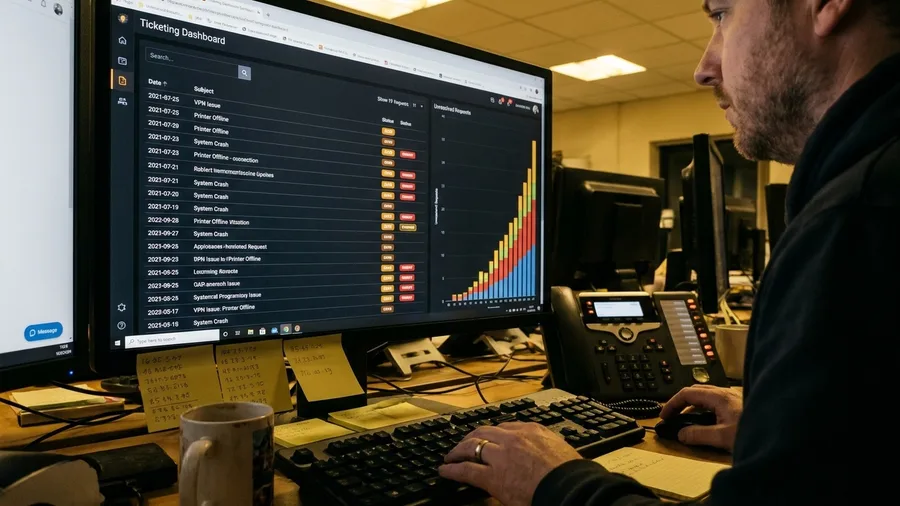
Ask people what finally tipped them and they rarely describe the machine. They describe the wait after they reported it.
At the example firm a routine ticket gets a first reply in two to three business days, and a hardware swap takes two to three weeks. Three weeks of hot-desking on a dying unit, saving every file twice, warning clients that the connection may go. The laptop is already failing. Now the calendar says it will keep failing until roughly the middle of next month.
Then there is the loop people learn by heart. Restart it. Restart it again. Reinstall the driver. The ticket closes marked resolved, the fault is back the following Tuesday, and the fix never happened. Open a new one and the cycle starts over.
What that loop teaches is not that the laptop is bad. It is that nobody owns the problem.
Those are two different experiences. A slow fix with a stated date you can plan around is survivable. Silence with no owner is the version people repeat to colleagues over lunch and to recruiters six months later. The cost is the hours spent chasing plus the certainty, each week, that the chase will end the same way.
So measure the right thing: the time from report to working again. Not tickets closed, not first response, not ticket volume. Those numbers reward closing, and closing is exactly what stops the fixing.
The 45 minutes is only half the bill. The queue adds the rest and sends it every month.
⚠️ COMMON MISTAKE
Don't measure tickets closed
A helpdesk that closes tickets fast can still leave staff waiting weeks for a fix. Track time from report to working again, and you will see the queue the way employees feel it.
Slow tech tells employees they do not matter
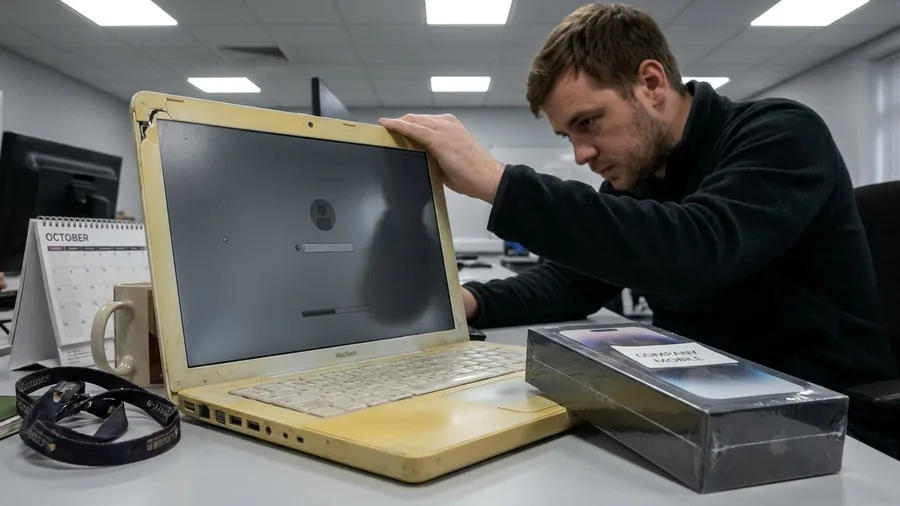
Because a machine that stalls every morning reads as a message about whose hours count. The 4.5-year-old laptop loads a verdict long before anyone types a password: the firm will approve a new CRM seat, a client dinner, a conference badge, and still not this.
The employee makes the arithmetic themselves. A $1,200 replacement against six minutes of their day, every working day, and they conclude their time ranks somewhere below a trade-show lanyard.
That reading appears in exit conversations that name the equipment before they mention salary, in engagement-survey comments about 'basic tools,' and in the referrals that thin out from senior people whose signature once carried weight.
New hires feel it fastest, measuring the promise from week one against a 6-minute boot and three tools that will not sync. Remote staff have no colleague to borrow a spare from, and client-facing staff stare at a spinning cursor on a share screen while a customer waits.
A strong salary and a decent manager buy real tolerance, enough to absorb a dropped call and a restart. That patience lasts exactly until the manager changes or the raise fails to arrive.
The 45 minutes is what the audit measures. The meaning workers attach to it is the multiplier that turns a slow machine into a loaded one.
The 91% measures intent, not actual exits

It measures how many people would consider walking, and those people are testing whether the job matches the promise, not clearing their desks. The headline's figure comes from the article's own survey, and the source, sample size and fielding date appear in the published report, linked for anyone who wants to check the wording.
A respondent pays nothing to tick 'yes, I would consider leaving.' A resignation costs something real: a signed offer, a start date, the awkward conversation with a manager, the risk that the new tool is just as old.
Most people who answer yes never cross that line, and the survey never claimed they would.
It also tells nobody how many of the 200 staff at your firm will actually go. A national sample cannot see your team, your refresh cycle, your support queue.
The numbers that can sit in an exit-interview file from the last twelve months, and in the voluntary turnover inside one team. Both are local, both are already recorded, and neither depends on a national headline.
Remote and hybrid staff feel it first
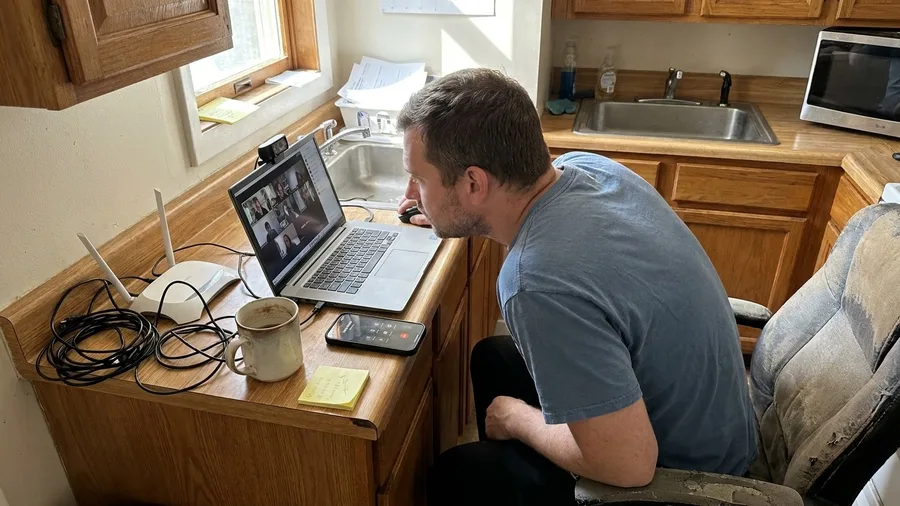
The people whose work runs from a kitchen table hit the friction first and hit it hardest. Roughly one in five video meetings starts late or drops, and a $50-a-month internet stipend does nothing about it. The stipend pays for bandwidth. It does not pay for the laptop that cannot carry the call.
Look at where the capital goes. The 2017 conference-room gear is budgeted, scheduled and replaced on a cycle. The kitchen-table setup is a stipend and somebody's personal router, and the conference room gets fixed first every time.
Fully on-site teams on dependable shared equipment will not recognize this. Their version of the same tax shows up in the ticket queue, not the call.
A manager can spot it without a survey. Remote staff join calls five minutes early as a buffer, keep cameras off, or dial in by phone as a backup. Those are workarounds against the setup, not personal preferences.
What remote staff get vs. what the conference room gets
Remote setup
- $50/month stipend; $50 does not cover one dropped call
- 4.5-year-old laptop, 6–8 minute boot
- Ticket answered in 2–3 days; swap in 2–3 weeks
- No spare unit: buy at $1,100–$1,400
Conference room
- 2017 gear, still on the schedule
- Swap done in 2–3 weeks, same as a laptop
- Fixed first because it is a line item
- Shared, so one failure is visible to all
Your best troubleshooters leave first
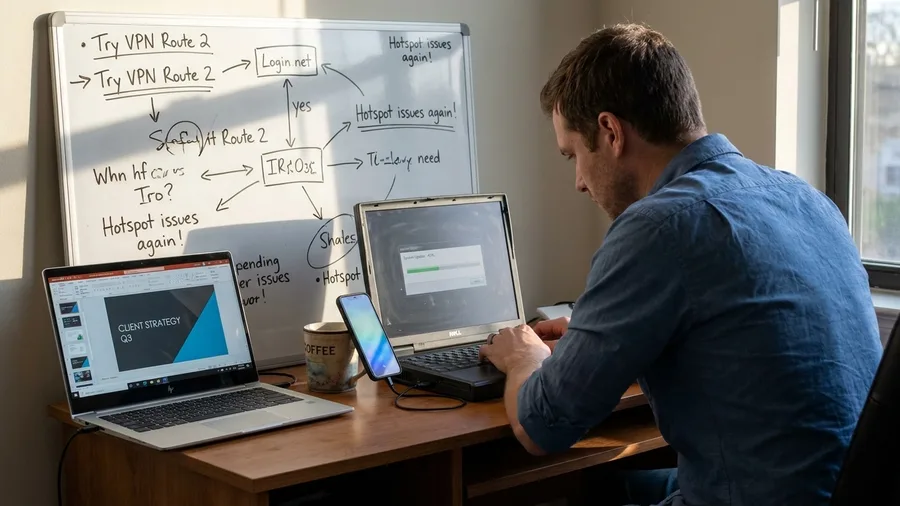
The employee who keeps a personal MacBook for the client deck is the same one a recruiter reaches in a week, because adaptable skills travel.
Picture the desk of your most capable colleague: a personal laptop loaded with the deck the work machine chokes on, a handful of shadow apps that hold the data the three sanctioned tools never sync, a small script they wrote at 7am on a Tuesday to stop re-entering the same client list, and a phone hotspot for the 2pm call that drops without fail. None of it appears on any asset register. All of it keeps the work moving.
And here is why no manager flags it. A workaround looks exactly like competence from the other side of the room.
The person who never files a ticket and never mentions the six-minute boot reads as self-sufficient, the steady hand who just gets on with it. Nobody sees the twenty minutes of setup they absorbed at home, or the $50 stipend that never covered the second screen. When they eventually hand in notice, they take the scripts, the folder shortcuts and the four years of undocumented fixes with them. The replacement inherits the raw machine, with none of the scaffolding, and starts the whole workaround economy from zero.
Then look at who is left after that resignation, and notice what the turnover figure is telling you.
The colleagues who cannot easily move stay put, which keeps the monthly attrition number pleasantly low. That number is doing quiet damage. It reads as stability to anyone in a budget meeting, when what it actually measures is who had the fewest options, not who was least affected by the tools.
The 45 minutes rarely makes it into an exit interview. By the time the most capable staff leave, they had already engineered it down to twenty, and spent the difference out of their own evenings.
Workaround economy — at a glance
📊 The 91%
Survey figure, not a quit rate
⏱ Time tax
30-60 min a day, before workarounds
🎫 Ticket backlog
2-3 days to answer, 2-3 weeks to swap
💵 The fix
200 laptops at $1,300: $260,000
Key insight
45 min a day across 200 staff at $70,000 is about $1.3M in paid hours a year.
Others stay and quietly stop trying

The colleague who never leaves but stops volunteering the extra check is costing the firm more per year than any single resignation, and no exit interview will ever record it.
Watch a disengaged specialist's week. Replies go out a day later. The slide deck arrives at the version that satisfies the brief and not one slide further. The quality check nobody formally assigned gets quietly dropped, because why chase it when the file share lags and the machine restarts mid-review. Ask for a workaround and you get a flat 'that's an IT problem,' where two years earlier the same person would have built one in a lunch break.
Compare that to a leaver. A resignation at least triggers a backfill, a job advert, a handover document, a manager who knows to act.
A disengaged specialist on a $70,000 salary stays on payroll at full cost while client emails get answered in a defensive tone, timelines slip by a week at a time, and the account manager spends Friday afternoons smoothing a relationship that used to run itself. The replacement budget never appears, because nobody left. That is what makes it invisible to the finance team and expensive to the firm.
Engagement surveys rarely surface it, either. They ask about workload, recognition and management, questions this friction never touches, and the person filling them in is not going to volunteer 'my laptop is four and a half years old' in a free-text box about culture.
The one signal worth watching sits in your own helpdesk dashboard. A team whose ticket volume falls while its missed deadlines climb has not fixed anything. Fewer reports, more slippage means people gave up on the queue and started eating the cost in silence.
The 45 minutes still gets spent every day. It has just stopped being mentioned.
📉 How quiet disengagement sets in
Workaround becomes routine
The employee finds a personal fix and stops reporting the problem.
Reporting drops
Tickets fall because people assume nothing will change.
Effort narrows
Deliverables get the minimum version; extra checks disappear.
Deadlines slip
Missed dates increase while ticket volume stays low.
Turnover stays comfortable
The problem hides because no one resigns over it.
The fix costs less than the leak

Fixing the whole 200-laptop fleet runs about $65,000 a year, and the hours it currently burns run roughly twenty times that, which is the whole argument in one comparison.
Start with the purchase side. Two hundred replacement units at $1,300 each comes to $260,000, spread across a four-year refresh that works out near $65,000 annually. Add identity and IT-service tooling at $15 to $40 per user per month, and you have a real number a finance director can approve without flinching.
Now the other column. Take 200 staff losing 45 minutes apiece each day against a $70,000 average salary, and the paid hours come to roughly $1.3M a year. That is before you count recruiting: replacing one $70,000 role costs about $9,000 in agency and advert fees, plus around ten weeks of reduced output while the seat is empty and the new hire learns the ropes.
Then run the figures honestly, because a finance manager will.
Not every minute lost to a restart turns into a minute of lost client work. Cut the estimate to a fifth of the lost time and the leak still lands near $260,000 a year, which is the entire annual refresh. The arithmetic survives its own worst case, and that is the version worth bringing to the meeting.
Both columns describe one illustrative 200-person firm, not a benchmark anyone should quote as industry truth. Swap in your own headcount, your own average salary and the actual quote from your hardware supplier. The ratio will move. The shape of the gap usually does not.
Start with an audit, not a purchase
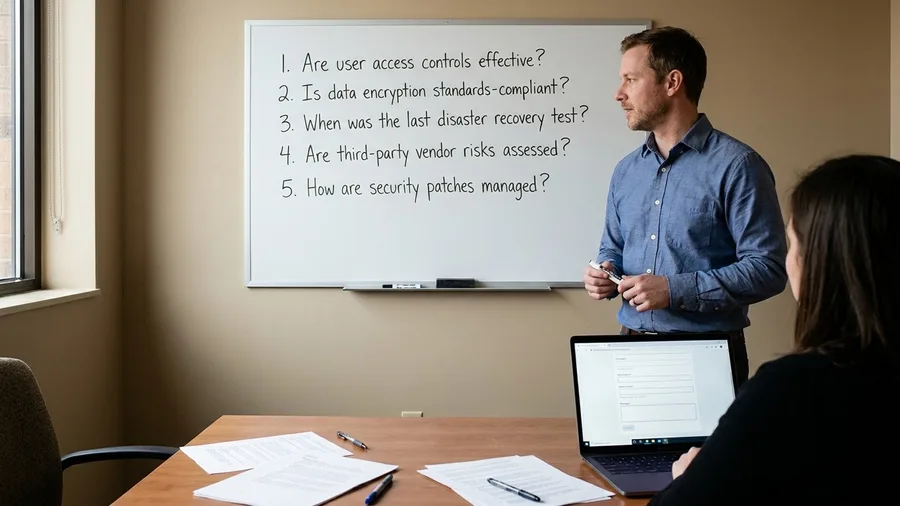
The first move costs nothing but a conversation with five or six people per team. Ask each of them the same five things: what breaks, how often, how long it takes to get working again, what they lose when it does, and how long support takes to respond. Twenty minutes of listening beats a company-wide survey nobody fills in.
Their answers are the entire case, in their own words, on one page.
The second free move sits on the IT side: a response time written down and posted where staff can see it. A committed figure such as 24 hours for a routine ticket does two things at once – it gives people something to plan around, and it turns a rumour into a number anyone can check. Silence was the part that made the queue feel hopeless; a date is what makes it survivable.
If money does exist, do not order 200 laptops. Buy for the worst-performing group first – the client-facing team carrying the 4.5-year-old fleet, or the remote staff running the oldest machines in the building – and refresh the rest when the next group's numbers make the case. One team fixed is a measured result; a company-wide rollout is a budget line that gets argued about for a year.
Some firms should skip the audit entirely. If you already refresh on a four-year cycle and support answers the same day, the five questions will tell you nothing you do not know, and your one bottleneck is somewhere else – find it in your own numbers instead of running a survey to confirm the obvious.
For everyone else, this week costs five questions and an email.
Frequently Asked Questions
What exactly is the one tech problem behind the 91% figure?
It is everyday unreliability: slow boots, dropped video calls, tools that do not sync, and support queues that take days or weeks. It is not a single outage or breach, which would get immediate attention. The daily accumulation of small failures is what wears people down.
Does the 91% mean most employees will actually quit?
No. The 91% measures intent — people saying they would consider leaving. Actual attrition requires an offer, a decision, and a resignation. Most people who say they would leave never do. Use local turnover and exit-interview data to judge your own company.
How do I measure the cost of bad tech in my own company?
Start with a five-question audit: what breaks, how often, how long to fix, what you lose, and how long support takes to respond. Multiply the lost minutes by headcount and average salary for a rough annual figure. Then compare that to your refresh quote.
What is the cheapest first fix if there is no budget?
Publish a service standard. Have IT commit to a written response time and post it where staff can see it. That costs nothing and turns a rumour into a checkable number. Pair it with the five-question audit to know where to spend later.
Should we replace all laptops at once or phase it?
Phase it. Start with the worst-performing group — often client-facing or remote staff on the oldest machines. A company-wide refresh ordered at once spreads budget thin and may not address the actual bottleneck.
Why do the best troubleshooters leave first?
Resourceful people find workarounds — personal laptops, shadow apps, phone hotspots — and have the most portable skills. When they leave, the scripts and local knowledge go with them. Managers often miss this because workarounds look like competence rather than a symptom.
Run the five-question audit before you order a single laptop
The 91% is stated intent, not a forecast, so treat it as a warning rather than a prophecy. The leak is real: at the example 200-person firm, roughly $1.3M a year in paid hours against about $65,000 a year to refresh the fleet. That gap is why the conversation is worth having and why it is winnable.
This week, at no cost, ask five or six people per team what breaks, how often, how long it takes to get working again, what they lose when it does, and how long support takes to respond. Get one written response time from IT. Then bring one sentence to your manager: "My team is losing about X hours a week to restarts and dropped calls, the average ticket takes 2-3 days, and the oldest devices are in one group – can we fix that group first?"
If your company already refreshes on a four-year cycle with same-day support, skip the audit and go straight at your one specific bottleneck. Everyone else: the machine that makes someone wait every morning is the cheapest resignation letter a company will ever receive, and the audit costs nothing but the questions.
Run the five-question audit this week
Ask your team what breaks, how long support takes, and what they lose. Bring one sentence to your manager — no budget, no vendor, no meeting required.