
In a groundbreaking development, scientists at Universidad Complutense de Madrid in Spain have constructed a revolutionary solar cell capable of achieving an impressive 60% energy conversion efficiency.
This ambitious target significantly surpasses conventional limits and could potentially reshape the solar energy industry.
The remarkable solar cells were created using gallium phosphide (GaP) and titanium (Ti), a novel combination that has taken researchers, led by Javier Olea Ariza, over 15 years to develop.
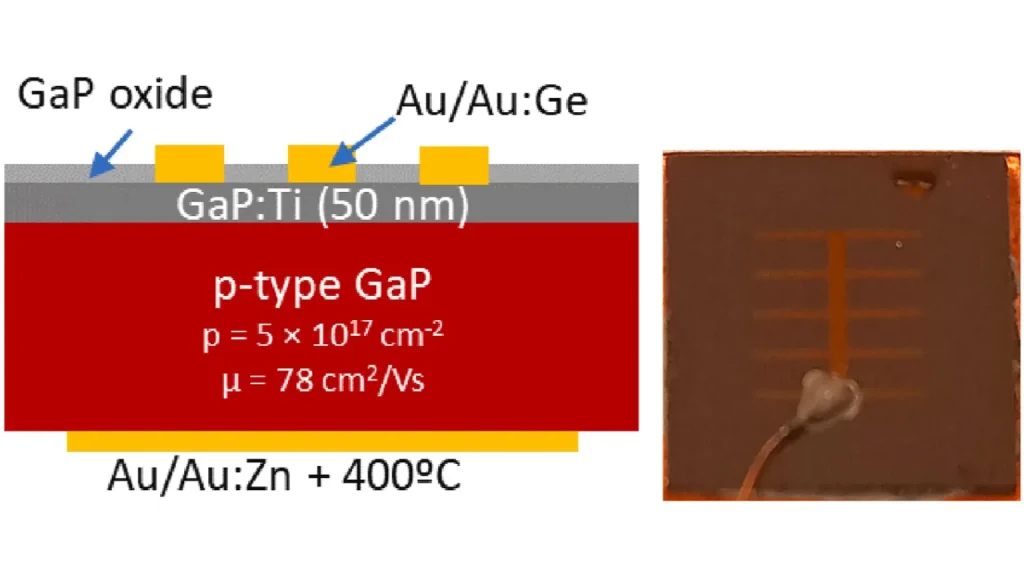
These intermediate band (IB) solar cells are designed to breach the long-established Shockley-Queisser (SQ) limit, which dictates the theoretical efficiency ceiling for single p-n junction solar cells.
For silicon-based solar cells, the SQ limit is approximately 33.7 percent.
The use of GaP and Ti in constructing the solar cells is key to their potential success.
GaP, with a bandgap of 2.26 eV, is closer to the optimal theoretical value needed for efficient conversion of sunlight to electricity.
This material composition enables the solar cell to capture a broader spectrum of light, particularly enhancing absorption at wavelengths above 550 nm.
The structure of the cell itself, a mere one cm² in size, includes a GaP:Ti absorber layer no thicker than 50 nm and features strategically placed metal contacts of gold and germanium.
However, despite the promising theoretical projections, the practical realization of these cells faces significant hurdles.
Currently, the efficiency of these newly created devices remains poor, with significant work required to transform theoretical potential into tangible results.
The researchers plan to continue refining the prototype to enhance its efficiency further and resolve construction issues, including optimizing the incorporation of Ti and achieving better surface passivation techniques.
The pioneering steps taken by the Spanish research team suggest that commercial deployment is on a distant horizon.
Yet, their findings highlight that our understanding of solar cells is no longer the bottleneck—now it’s about mastering the technology to reach these unprecedented efficiency levels in practical applications.
As the research advances, there is hope that the technological barriers can be overcome, potentially paving the way for a new era in solar energy efficiency, which might ultimately contribute to meeting rising global energy demands more sustainably and efficiently.
For now, the innovative GaP:Ti solar cells mark a significant step forward in solar technology research, hinting at the future of more efficient, and potentially transformative, solar solutions.