
The Department of Defense (DoD) has officially started the groundbreaking work on Project Pele, a visionary initiative to revolutionize battlefield energy supply with a transportable high-temperature gas-cooled nuclear reactor.
The project, undertaken at Idaho National Laboratory (INL), entails designing, building, and demonstrating a prototype mobile nuclear reactor within five years.
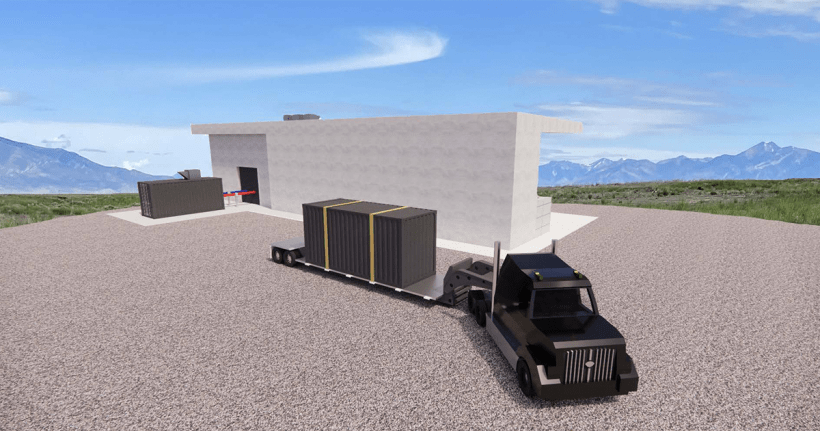
The microreactor, crafted by BWXT Advanced Technologies in Virginia, will be the first-ever fourth-generation nuclear reactor to produce electricity in the United States.
The final reactor assembly is slated to commence in February 2026. According to the DoD’s press release, the prototype is designed to be transported within four 20-foot shipping containers, showcasing its mobility and ease of deployment.
Energy has been identified as a critical component for future military operations, particularly in remote and austere environments.
Consequently, Project Pele—named after the Hawaiian goddess of fire and power—aims to deliver reliable and transportable energy solutions for such scenarios.
The Defense Science Board highlighted in 2016 the rising energy demands on battlefields, underscoring the necessity of innovative energy solutions like this.
The high-temperature gas-cooled reactor can produce between 1 to 5 megawatts of electrical power for more than three years without needing refueling.
Initially, two designs were shortlisted, and BWXT’s design was ultimately selected for development by the DoD’s Strategic Capabilities Office (SCO).
Upon its arrival at INL, the microreactor will be connected to the lab’s specialized electric microgrid through comprehensive piping and electrical wiring.
The concrete shield structure to house the reactor will be constructed in the coming year, in anticipation of the reactor’s placement in 2026.
After a final safety review, Project Pele’s team will proceed with the initial Test and Evaluation plan.
Dr. Jeff Waksman, Project Pele’s program manager, expressed excitement about moving beyond conceptual stages towards tangible advancements.
He emphasized that the collaboration with INL and the Department of Energy is setting a new standard for both the manufacturing and regulation of advanced reactors.
Dr. John Wagner, INL’s director, noted that INL has been a bastion of nuclear innovation for 75 years.
He anticipates that Pele will be among the first of a new generation of advanced experimental reactors hosted at the lab before the decade concludes.
Project Pele is a collaborative government effort involving expertise from various agencies, including the Department of Energy, the U.S. Army Corps of Engineers, and NASA.
The initiative will serve as a testbed within the United States, under the stringent safety oversight of DOE’s Idaho Operations Office.
The reactor is expected to operate for a minimum of three years, demonstrating the use of clean, reliable, and transportable nuclear power.
This stands to significantly impact energy supply chains for military bases nationwide.
Moreover, BWXT intends to apply the lessons learned from Project Pele to advance their civil-focused BANR microreactor, thereby contributing to the domestic supply chain for high-temperature gas reactor components and TRISO fuel production.
As Project Pele progresses, it promises to be a groundbreaking step in military and civilian nuclear energy applications, pushing the boundaries of what is possible with mobile nuclear technology.
Learn more about Project Pele here.