
Mount Erebus, located in Antarctica, is no ordinary volcano.
Amid the otherworldly icy expanse, this volcano distinguishes itself with its constant volcanic activity and emitting gold dust daily.
This unique occurrence makes Mount Erebus a geological wonder and a hidden treasure trove in one of the Earth’s most remote regions.
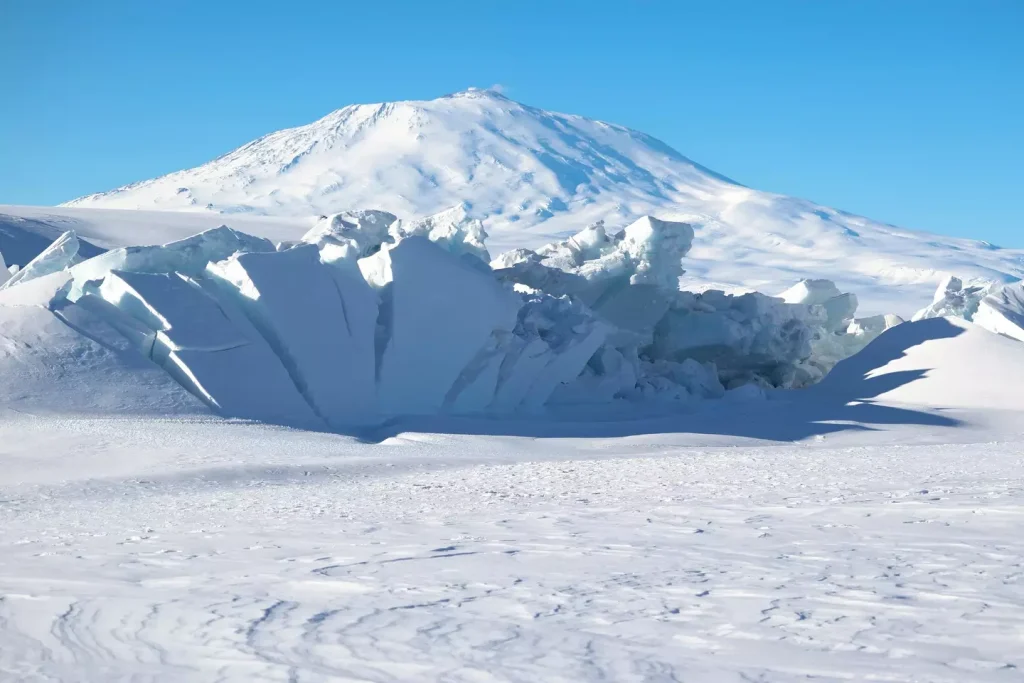
The phenomenon of Mount Erebus spewing gold began to catch scientific attention due to its rarity.
Research indicates that the volcano releases about 80 grams of gold dust each day, amassing a daily value of roughly $6,000.
While this may sound like a lucrative opportunity, the extreme and dangerous conditions of Antarctica make it less accessible for treasure hunters.
Mount Erebus stands at an impressive 12,448 feet (3,794 meters), making it the tallest volcano on the Antarctic continent.
First discovered in 1841 by Captain Sir James Clark Ross, it is one of only two active volcanoes in Antarctica amidst a total of 138 identified volcanoes.
Its continuous activity, since it became active again in 1972, is a unique feature among its peers.
According to scientists like Conor Bacon from the Lamont-Doherty Earth Observatory at Columbia University, the release of gold dust from Erebus is a rare geological event.
The specific conditions that allow the volcanic surface to remain unfrozen and consistently spew out elements create a perfect setting for tiny crystals of metallic gold to form.
These gold particles are only 20 micrometers across and are emitted into the air alongside gas and steam at temperatures reaching 1000°C.
Interestingly, the particles have been found as far as 621 miles away from the volcano, carried by powerful volcanic fluxes.
One of the unique aspects of Mount Erebus is its calm volcanic behavior, contrasting with the explosively erratic nature of many other volcanoes.
According to Philip Kyle from the New Mexico Institute of Mining and Technology, Erebus’ slow release of gases allows for the gradual formation of gold crystals, a process that would be impossible in more violently eruptive volcanoes.
Mount Erebus holds a significant place not only in geology but also in history.
It was the site of the tragic 1979 Air New Zealand Flight 901 disaster, where a sightseeing flight collided with the volcano, resulting in the loss of all 257 people onboard.
Despite the perilous environment of Antarctica, scientists have made it possible to observe the volcano from nearby research bases.
The continuously molten lava lake within Erebus has been a research subject for decades, providing insights into volcanic behaviors and the extraordinary creation of gold dust.
In conclusion, Mount Erebus stands as a testament to the wonders and mysteries of our planet, combining the harsh beauty of Antarctica with the sparkling allure of gold.