
In a groundbreaking development, researchers from the Technical University of Munich (TUM) have successfully built the world’s first supramolecular motor that operates on chemical fuel.
This pioneering achievement opens new avenues for potential medical innovations, from delivering drugs to detecting tumor cells within blood vessels.
The inspiration for this microscopic motor, which represents a quantum leap outside the biological realm, comes from the natural world.
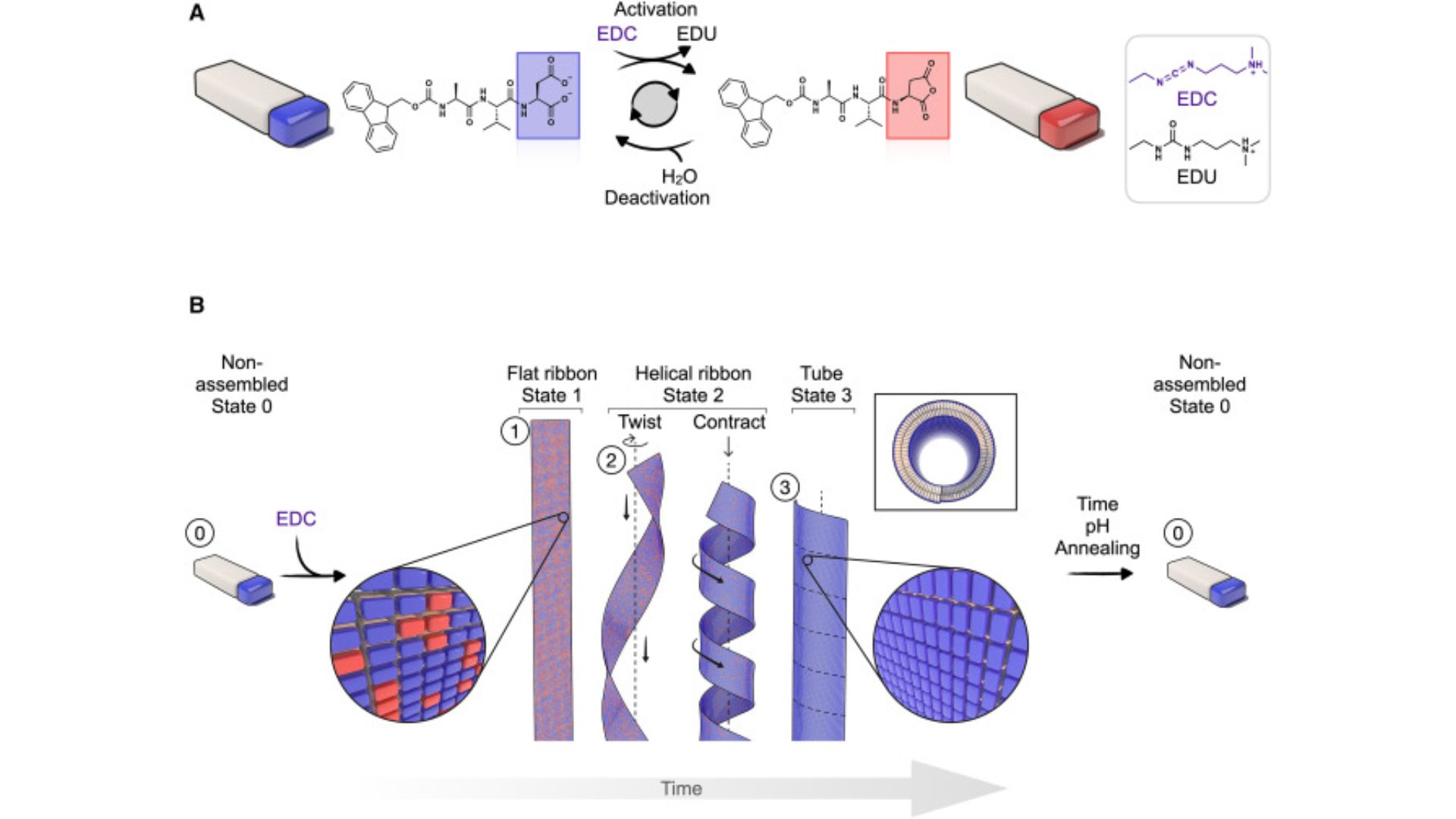
Just like bacteria such as archaea that use Adenosine Triphosphate (ATP) to power their tiny fin-like flagella, the TUM researchers, led by Job Boekhoven, crafted peptide ribbons driven by a chemical fuel, different from ATP. These ribbons, made of amino acid chains, curl into small rotating tubes when activated by the chemical fuel.

This innovative motor stands at just a few micrometers in length and nanometers in width, yet its motion can be directly observed under a microscope.
The motor’s rotation speed can be modulated by varying the fuel amount, while the direction can be controlled based on the structural makeup of the peptide ribbons.
To gauge the motor’s practical applications, the team collaborated with Prof. Matthias Rief from TUM, a specialist in molecular biophysics and optical measurement methods.
Their findings revealed that the activated ribbons generate sufficient force to move objects a few micrometers in size.
This discovery lays the foundation for creating minuscule devices, or “microwalkers,” that might one day navigate through the human body for various medical missions.
These microwalkers could potentially transport medications to specific organs or swim through blood vessels to locate and identify tumor cells.
However, significant challenges remain, notably the toxicity of the current chemical fuel, which precludes its use in living organisms.
The TUM team’s breakthrough has been documented in the journal Chem, under the title “Synthetic flagella spin and contract at the expense of chemical fuel.”
This research signifies a crucial step towards turning science fiction concepts of nanorobots and microdevices into reality, transforming medical treatment modalities in the process.