
For years, scientists have speculated that bowhead whales communicate across vast distances.
New research offers the most compelling evidence yet, showing that two whales, separated by as much as 100 kilometers, synchronized their diving schedules, suggesting that they might be in contact.
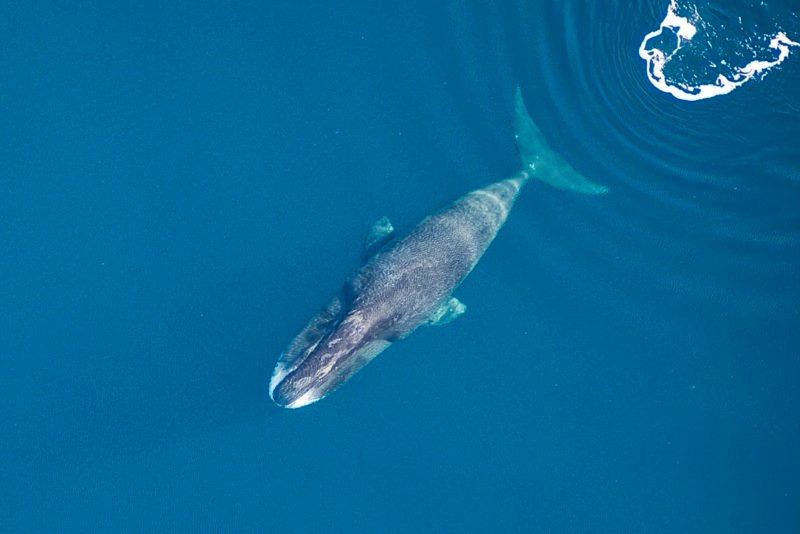
Each year between January and May, a large bay on Greenland’s west coast, Qeqertarsuaq Tunua, becomes a bustling hub of plankton, inviting baleen whales, including bowhead whales, to feast.
In 2010, two of these whales entered the bay and began to demonstrate synchronized diving, despite being 100 kilometers apart—well beyond each other’s visual range, yet likely within hearing distance.
This observation supports a theory that biologist Roger Payne and oceanographer Douglas Webb proposed in 1971.
Their “acoustic herd theory” suggested that baleen whales communicate acoustically over hundreds of kilometers, traveling in geographically diffuse herds.
Payne’s earlier work in discovering humpback whale songs along with insights into the social behaviors of toothed cetaceans like killer whales and dolphins laid the foundation for this theory.
Despite the compelling anecdotes over the years, no scientific proof existed until researchers from a multidisciplinary team dredged new evidence from bowhead whale diving data.
Evgeny Podolskiy, an environmental scientist at Hokkaido University in Japan, led the pioneering study.
By attaching satellite tags to 12 bowhead whales in the Arctic, they collected diving-depth and location data over 144 days, uncovering patterns previously shrouded in randomness.
The results were intriguing.
The whales followed a 24-hour cycle in their diving behavior, shallow in the mornings and deeper in the afternoons, correlating with diel vertical migration—the daily movement of plankton and other tiny marine creatures.
Even more fascinating was the synchronized diving observed between two whales over seven days whenever they were within 100 kilometers of each other, aligning with the maximum acoustic range for whales in the area.
Though this synchronized diving might be coincidental due to specific ocean conditions, the persistent behavior over several days points towards a likelihood of communication.
Christopher Clark, a bioacoustics researcher at Cornell University, noted that while Podolskiy’s observations are compelling, confirming acoustic communication requires more analysis due to the slow transmission speed of low-frequency sound in cold water.
For Susan Parks, a behavioral ecologist at Syracuse University, the mathematical rigor of Podolskiy’s approach adds significant potential.
She suggests using recorded sound data in future studies to conclusively demonstrate that whale calls reach and influence whale behavior across long distances.
This would pave the way for definitive proof of acoustic herd theory.
Matthew Payne and Webb’s theory may yet be valid—a revolutionary idea further supported by this new research.
The synchronization of diving behavior between two bowhead whales acts as a promising clue while posing interesting questions on what these creatures might communicate about.
Could they be coordinating to avoid predators or human activity, sharing news on food availability, or perhaps playing a long-distance game akin to Marco Polo?
Until more sophisticated studies confirm these signals’ purposes, the mystery of long-distance whale communication keeps researchers and marine enthusiasts alike intrigued.