
The idea of enhancing human capability through technology has taken a significant leap with the creation of the ‘Third Thumb.’
Engineered by Professor Tamar Makin’s team at the University of Cambridge, this innovative device is a robotic thumb designed to augment the user’s range of motion and hand capabilities.
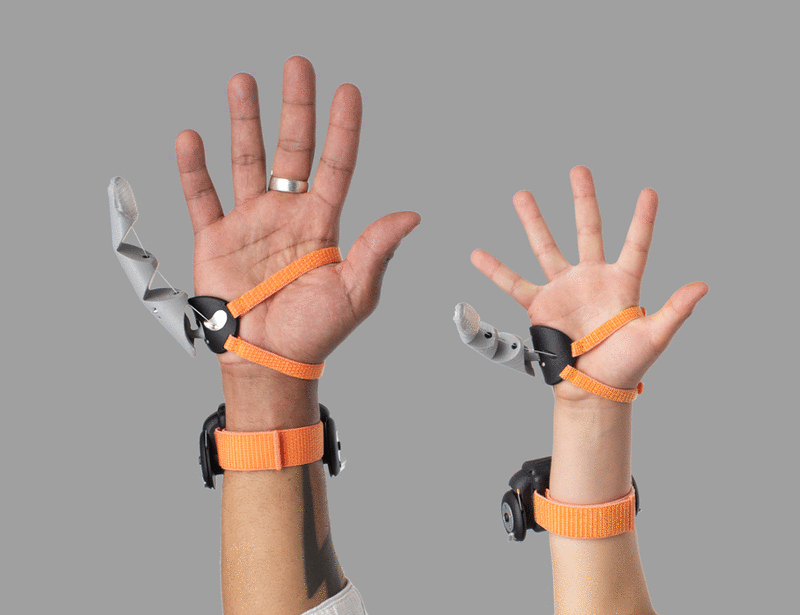
It signifies a pivotal point in the ongoing evolution of motor augmentation, opening new doors for the integration of technology into daily human activities.
The ‘Third Thumb’ is uniquely tailored to provide users with increased grasping abilities and an enhanced carrying capacity.
This lightweight device functions as a wearable technology, allowing users to undertake tasks that would otherwise be complicated or unattainable.
Perhaps most exciting is the potential impact on individuals with disabilities.
The Third Thumb offers the ability to perform intricate tasks single-handedly, thus enhancing independence for users with compromised limb function.
Professor Makin emphasizes the transformative potential of technology, stating, “These technologies open new opportunities that can benefit society, but it’s crucial we ensure their availability to all, including marginalized communities who often miss out on technological advancements.”
The functioning of the Third Thumb is intuitive.
It comes equipped with pressure sensors that the user controls via their big toes. Applying pressure with the right toe moves the thumb across the hand, while the left toe enables upward movement toward the fingers.
Such design ensures seamless interaction while minimizing cognitive load on users.
The device’s effectiveness was tested at the 2022 Royal Society Summer Science Exhibition, involving 596 participants aged between three to 96 years.
Remarkably, 98% of the participants could successfully maneuver objects using the Third Thumb within just one minute.
During the trial, participants were tasked with two primary exercises. In one, they had to move pegs into a basket by picking them from a pegboard.
In another, they manipulated various foam objects, each demanding distinctive dexterous approaches.
The trial demonstrated the Thumb’s functional ease and adaptability across different tasks and people.
Dani Clode, involved in the design, posits that augmentation involves creating a new relationship with technology, turning it into an extension of the human body.
This perspective underlines the importance of inclusivity and ease of access within the development phase of such devices.
Additionally, Lucy Dowdall, a co-author involved in the study, stresses on human-machine interactions needing to integrate smoothly with users’ cognitive and motor abilities.
She insists on the necessity to account for varied demographics—ranging across different ages, genders, and cultural backgrounds—during product development.
The Third Thumb, emerging as a beacon of possibility within wearable technologies, demonstrates how human-machine interfaces might soon redefine our day-to-day interactions.
By embedding inclusivity at the heart of its development, this invention stands as a testament to how technology can be seamlessly woven into the fabric of human life, providing enhanced physical capabilities.