
Amid growing global water scarcity, an innovative technology reminiscent of science fiction is emerging to tackle the crisis: extracting water directly from the atmosphere.
This revolutionary approach is being utilized worldwide, though its high costs present significant challenges to widespread adoption.
According to the United Nations Food and Agriculture Organization, water scarcity affects half of the world’s population at least once a month.
By next year, it’s predicted that 1.8 billion people will experience absolute water shortage.
In response, some inventive entrepreneurs have taken inspiration from Star Wars to extract clean water from the air, even in low-humidity regions.
The concept of generating water from air is more straightforward than it sounds.
Water vapor within the air is harnessed through two main methods: cooling and heating.
The cooling method involves chilling humid air to its dew point, causing water vapor to condense into liquid.
The heating approach uses hygroscopic materials to absorb humidity from the air, later releasing it when heated.
This technology can potentially operate on renewable energy, making it ideal for deployment in remote locations and aligning with sustainability goals.
Despite its promise, the technology is still considered too expensive to be a comprehensive solution to the global freshwater shortage.
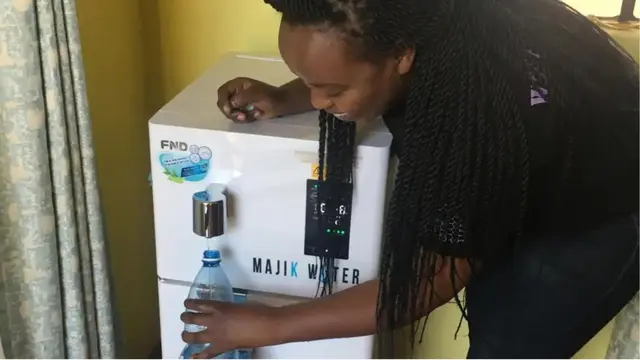
Beth Koigi, CEO of Majik Water, was first inspired to seek solutions to water purification due to personal hardship in Kenya during a drought.
Her company now offers scalable solutions capable of generating up to 500 liters of water in a day with cooling-based systems.
However, Koigi acknowledges that costs remain prohibitive for long-term implementation.
In India, Swapnil Srivastav faced similar challenges during a drought in Kerala in 2016.
He founded Uravu Labs, which utilizes the heating method for water extraction and has scaled its operations to produce 2,000 liters of water in 12 hours.
Yet, like Majik Water, Uravu Labs finds the technology too costly for local communities and instead serves industries like hospitality and data centers looking to incorporate more sustainable practices.
Experts believe that innovative focus on components such as heat exchangers, hygroscopic materials, and condensers, combined with government support and environmental regulations, could make water-from-air systems more viable for widespread use.
Though the present economics are challenging, these groundbreaking innovations could one day be a game-changer in resolving global water scarcity issues.