
Amidst the global shift from fossil fuels to sustainable energy solutions, hydrogen power is emerging as a key player.
In an unprecedented move, South Korea is pioneering efforts to incorporate hydrogen technology into its military, promising to redefine operational efficiency while significantly cutting carbon emissions.
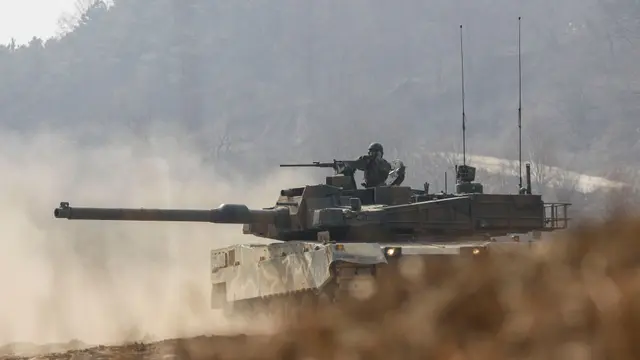
Notably, South Korea’s military, officially known as the Republic of the Korean Army (RoKA), is in the process of transitioning its military vehicles from internal combustion engines to advanced hydrogen engines.
Top Korean mobility technology firms like Hyundai, Kia, and Doosan are spearheading this shift with extensive government support.
Hyundai, for instance, is developing a hydrogen refueling vehicle dubbed the “H-Moving Station,” which can carry 50 kilograms of hydrogen and refuel in virtually any location.
Hyundai’s subsidiary, Hyundai Rotem, focuses on producing hydrogen engines for military tanks and armored vehicles, making the energy transition smoother and more effective.
Kia is also heavily involved, developing a hydrogen-powered all-terrain military vehicle named the EV9.
This vehicle will feature a 90-kilowatt fuel cell and a 6.3-kilogram hydrogen tank, yielding an impressive range of 480 kilometers.
Additionally, Kia is working on a portable hydrogen fuel cell generator, supported by nearly $3 million in government funding, to replace traditionally noisy and heat-intensive diesel models.
The technology is advantageous not only for its enhanced efficiency but also for its strategic benefits.
Hydrogen fuel cells boast an efficiency rate of at least 47 percent, significantly higher than the 28-32 percent efficiency of conventional fossil fuel power generation.
Moreover, hydrogen cells are smaller and lighter than traditional electric batteries, allowing for easier electricity generation and less detectable military operations due to their low noise and emission-free operation.
Beyond land vehicles, South Korea is expanding its hydrogen initiatives to include naval and aerial technologies.
Companies like Paprity and Hogreen Air are innovating in hydrogen engines for warships and submarines, while Doosan Mobility Innovation is developing hydrogen drones for the ROK Air Force.
These drones can fly for significantly longer periods compared to battery-powered counterparts, enhancing military surveillance and reconnaissance capabilities.
The larger goal of these advancements is twofold: to reduce the substantial carbon footprint of military operations and to strengthen national energy security.
A recent report highlighted that global military operations account for 5.5 percent of global emissions, a figure that South Korea aims to drastically reduce with hydrogen technology.
As an example, the US military alone consumes enormous fuel volumes, including an estimated 100 million barrels yearly in 2017.
Strategic international collaborations are also playing a crucial role.
South Korean President Yoon Suk Yeol and Japanese Prime Minister Fumio Kishida have agreed to cooperate on reducing hydrogen technology costs and establishing global regulations, which will be fundamental for the broader adoption of hydrogen fuel across military operations.
In summary, South Korea’s ambitious push towards hydrogen-powered military technology stands as a shining example of how sustainable energy solutions can transform even the most fuel-intensive sectors.
With ongoing projects addressing hydrogen infrastructure, including refueling stations and robust supply chains, South Korea is not only advancing its military capabilities but also contributing to global environmental goals.