
Approximately 42,000 years ago, a dramatic reversal of Earth’s magnetic field took place, an event known as the Laschamps event.
It was a period marked by significant changes, both in the environment and possibly in life itself.
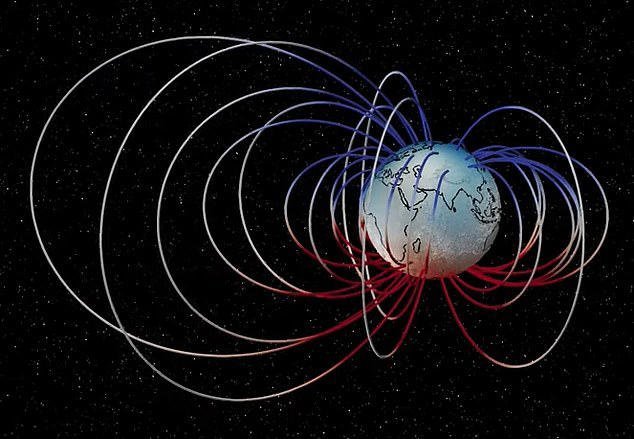
Now, thanks to data from the European Space Agency’s Swarm satellite mission, this turbulent historical event has been translated into a unique auditory experience.
Scientists from the Technical University of Denmark and the German Research Center for Geosciences have used satellite data, alongside geological evidence of magnetic movement on Earth, to map this ancient event.
The representation they created uses natural sounds like creaking wood and crashing rocks, generating a distinctive interpretation of the event that goes beyond traditional scientific analysis.

Earth’s magnetic field arises from the swirling motions of molten metals in our planet’s core, extending far into space.
This magnetic shield is crucial for deflecting particles from the sun that could strip away our atmosphere.
However, this protective barrier doesn’t always remain constant.
Occasionally, Earth’s magnetic field experiences polarity reversals, where north and south magnetic poles switch places.
The field’s most recent complete reversal, the Laschamps event, left its mark in the volcanic rocks of France.
During this event, the magnetic field weakened to a fraction of its current strength, enabling an influx of cosmic rays into the atmosphere.
This increase in cosmic radiation is evident in ice core and marine sediment records, reflected in elevated levels of particular isotopes like beryllium-10.
This isotopic change resulted from cosmic rays bombarding Earth’s atmosphere, leading to increased ionization and ozone layer depletion.
Such dramatic alterations in the environment potentially contributed to significant changes, including the extinction of Australian megafauna and shifts in human habitation patterns.
Understanding the Laschamps reversal is crucial as we contemplate the future possibilities of Earth’s magnetic field behavior.
As Sanja Panovska, a geophysicist at the German Research Center for Geosciences, highlights, studying these events helps in space climate prediction and gauging impacts on Earth’s systems.
Remarkably, the full reversal took around 250 years, remaining in the new orientation for about 440 years.
During the reversal, the magnetic field’s intensity was potentially reduced to just 25% of its normal strength as magnetic elements drifted.
Concerns about an imminent reversal today have been spurred by recent anomalies like the weakening of Earth’s magnetic field over the Atlantic Ocean, known as the South Atlantic Anomaly.
While this situation does expose satellites to increased radiation, current research suggests these irregularities are not definitively tied to reversal events.
Since 2013, the ESA’s Swarm constellation has been actively monitoring Earth’s magnetic signals, aiding researchers in decoding its complexities.
This ongoing surveillance is pivotal for demystifying our planet’s geomagnetic dynamics and anticipating its future transformations.