
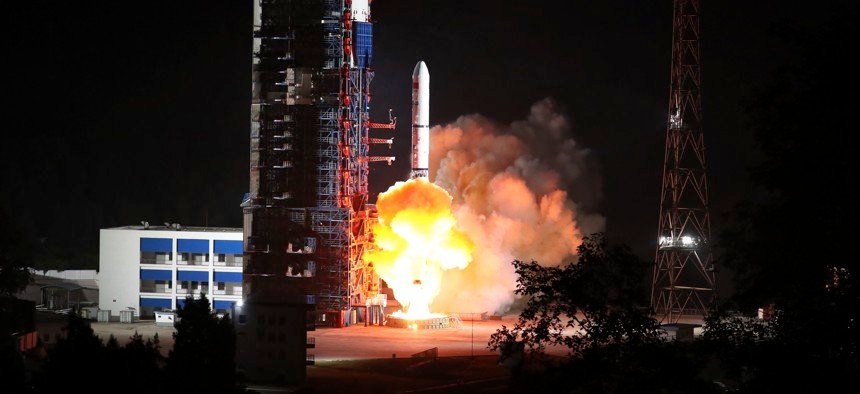
In an ambitious move to establish its own internet satellite network, China has launched the initial batch of its Qianfan, or “Thousand Sails,” satellite constellation.
The launch, which took place in August from Taiyuan spaceport on a Long March 6A rocket, marked the first step in what could become a massive array of over 14,000 satellites.
However, this development has astronomers sounding alarms due to the unprecedented brightness of these satellites.
The Qianfan satellites stand out starkly against the night sky, with their brightness ranging from a magnitude of 8 when low to 4 when directly overhead.
To put this into perspective, professional astronomers recommend a maximum of magnitude 7 to avoid interference with ground-based telescopes.
The Qianfan satellites exceed this by being brighter than all but 500 stars visible from Earth, and are bright enough to be seen with the naked eye.
This is more than just an aesthetic issue.
The brightness of these satellites can create streaks on telescopic images, disrupting astronomical research and amateur stargazing alike.
Anthony Mallama, a satellite brightness expert at the International Astronomical Union (IAU), emphasized that at their current magnitude, these satellites pose significant challenges for observing the universe.
Comparisons quickly arise between Qianfan and SpaceX’s Starlink constellation, which faced similar criticisms from the astronomical community.
However, SpaceX responded to concerns by actively working to reduce the brightness of its satellites, something the astronomical community hopes China might do with Qianfan.
Ian Christensen from the Secure World Foundation suggested that China might follow SpaceX’s example, as the country aims to be perceived as a responsible player in the arena of global space activity.
The design of the Qianfan satellites appears to lack features that could reduce their brightness, such as reflective mirrors that direct sunlight away from Earth, a mitigation measure that SpaceX employs.
Given that only a small portion of the Qianfan constellation has been launched, astronomers are pressing for changes before more of these exceptionally bright satellites fill the skies.
The challenge posed by Qianfan echoes louder as it’s not an isolated case.
AST SpaceMobile recently deployed a large antenna for direct-to-device services, raising similar concerns about its impact on night sky visibility.
Additionally, radio astronomers have detected unintended emissions from satellites like Starlink, affecting observations at low frequencies.
Federico Di Vruno of the Square Kilometer Array Observatory highlighted the urgent need to address such disruptions to preserve our skies as a resource for human discovery.
The international scientific community watches closely as China determines its next steps with Qianfan, bearing in mind the importance of maintaining a balance between technological advancement and the preservation of our celestial window.