
China’s innovative strides in space exploration have introduced a new development: a lightweight battery designed specifically for Martian conditions.
This battery, crafted by a team at the University of Science and Technology of China, marks a significant leap towards sustainable power sources in space missions.

Mars presents a unique challenge due to its harsh environment and complex atmospheric composition, where carbon dioxide predominates at 95.32%, along with traces of nitrogen, argon, oxygen, and carbon monoxide.
Added to this are the drastic temperature swings, varying by as much as 60 degrees Celsius (150 Fahrenheit) between day and night.
The need for a reliable energy source is crucial for future human exploration. The solution proposed by these Chinese scientists addresses these challenges head-on.
Their “Mars battery” ingeniously extracts its fuel directly from the Martian atmosphere.
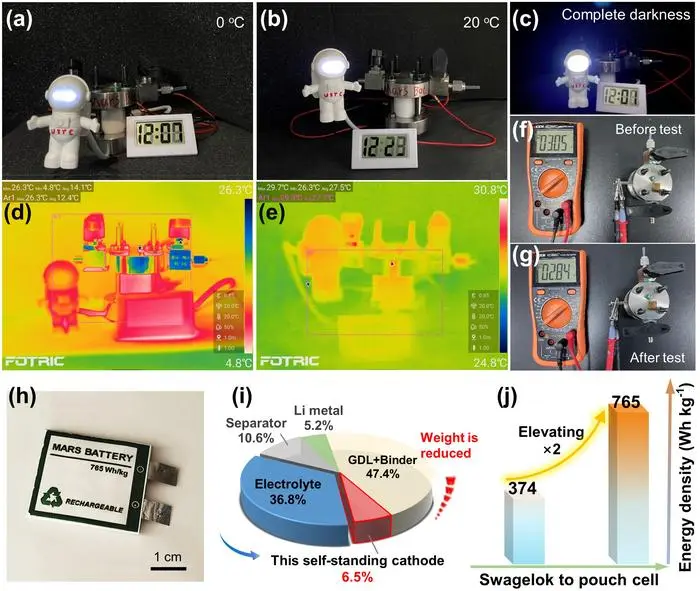
Functioning similarly to a fuel cell, the battery converts chemical reactions into electricity.
This approach significantly reduces the battery’s weight, which is a vital consideration for space travel.
What sets this battery apart is its ability to harness gases from Mars.
During the discharge phase, the battery’s electrodes engage with Martian gases like carbon dioxide and carbon monoxide, triggering a chemical reaction that produces electrical power.
When the battery depletes, it can be recharged using solar or nuclear energy, which are potential renewable energy sources on Mars.
Designed to weather Mars’ extreme conditions, the battery can operate continuously for over 1,350 hours—equivalent to nearly two Martian months.
Its robust design enables it to function even at freezing temperatures, maintaining an impressive energy density.
In their research, the team simulated Mars’ temperature variations to test the battery’s resilience.
It operated efficiently at 0°C (32°F), showcasing an energy density of 373.9 Wh/kg.
The battery’s charge and discharge involve the transformation of lithium carbonate, with atmospheric gases acting as catalysts, thus speeding up the conversion process.
To enhance its functionality, the researchers optimized its structure by incorporating a folded cell design to increase surface interaction with Martian gases.
This design improvement heightened the battery efficiency and energy capacity, making it even more suitable for space missions.
Future advancements aim at developing solid-state versions of these batteries to handle the low pressure and variable temperatures found on Mars, paving the way for more efficient space exploration systems.
This technological breakthrough, detailed in Science Bulletin, suggests a promising future for Mars exploration, potentially reducing dependency on conventional lithium-ion batteries used in current rovers.
Such innovations could be pivotal for prolonged human presence on the Red Planet, marking a new chapter in interplanetary exploration.