
A team of Chinese scientists has achieved a major breakthrough in wireless communications, transmitting high-definition video over 1.2 kilometers using terahertz technology.
This groundbreaking achievement has the potential to revolutionize future communication systems, including the anticipated 6G networks.
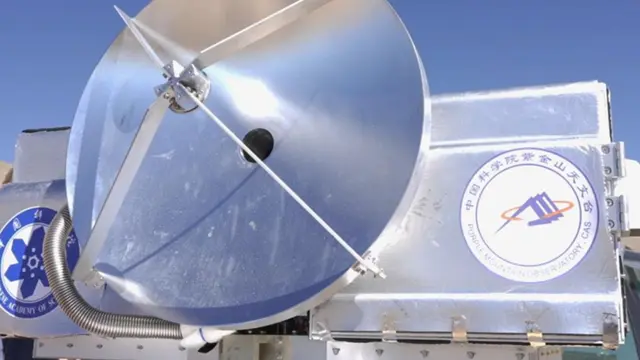
Conducted by the Purple Mountain Observatory of the Chinese Academy of Sciences, this experiment represents the world’s first use of high-sensitivity superconducting receivers in long-distance terahertz wireless systems.
The experiment took place at an astronomical observation base over 4,000 meters above sea level on the Qinghai-Xizang Plateau, providing ideal conditions for testing.
Terahertz waves, which lie between microwave and infrared frequencies, offer a wide bandwidth that could enable ultra-fast data transmission.
This advancement is likened to expanding a two-lane road into a multi-lane highway, drastically increasing data capacity.
Despite the challenges of severe signal attenuation over long distances, this innovative use of superconducting detection technology minimized energy loss, allowing the extremely faint signals—produced with just 10 microwatts of power—to travel far more efficiently than before.
The implications of this technological advancement are extensive, especially for high-speed data applications like real-time video streaming and high-capacity data transfers.
Additionally, this technology can enhance space communication, offering significant advancements for both terrestrial and extraterrestrial data exchange networks.
The development of terahertz technology since the 1990s has been focused on overcoming the barriers that limit such high-frequency communication.
However, there remain hurdles, especially in manufacturing scalable and cost-effective terahertz devices before this technology can become widely adopted.
This milestone not only paves the way for next-generation communications but also establishes a critical foundation for multidisciplinary platforms at submillimeter-wave observatories.
While challenges persist, the progress made by Chinese researchers illuminates the path towards faster and more effective communication technologies in the not-so-distant future.