
The marketing line is that every pedestrian in Leonida runs on AI. The reality is a decade-old, hand-built simulation that checks what a person could actually see, hear and know about you.
That is not a downgrade. Hand-authored state is why a reaction repeats tomorrow, and why a crowd feels like a neighborhood instead of a chat window.
This article breaks down what each GTA 6 NPC system records about the player, what you can control as a result, and what is still unconfirmed before launch on November 19, 2026.
| System | What it tracks or reacts to | What you'll notice in play |
|---|---|---|
| Pedestrian traits | Temperament, aggression level, profession, location, witnessed events, approach | One person flees and another confronts you from the same street |
| Weapon perception | Whether the gun is slung or held in hand, line of sight, following distance | Calm bystanders when the rifle is on your back; stepped-back fears when it is drawn |
| Audio and weather | Conversation fragments carried by wind, localized persistent conditions | Overhearing a line from farther upwind; rain that stays in one district |
| Law enforcement | Witnesses, victims, CCTV, clothing, appearance, weapons, vehicles | A search that closes a perimeter instead of spawning cars on top of you |
| Companions | Whether the group splits up or stays together during a pursuit | A companion who breaks off lowers the chance of the pair being spotted |
A separate team has been on this since 2014
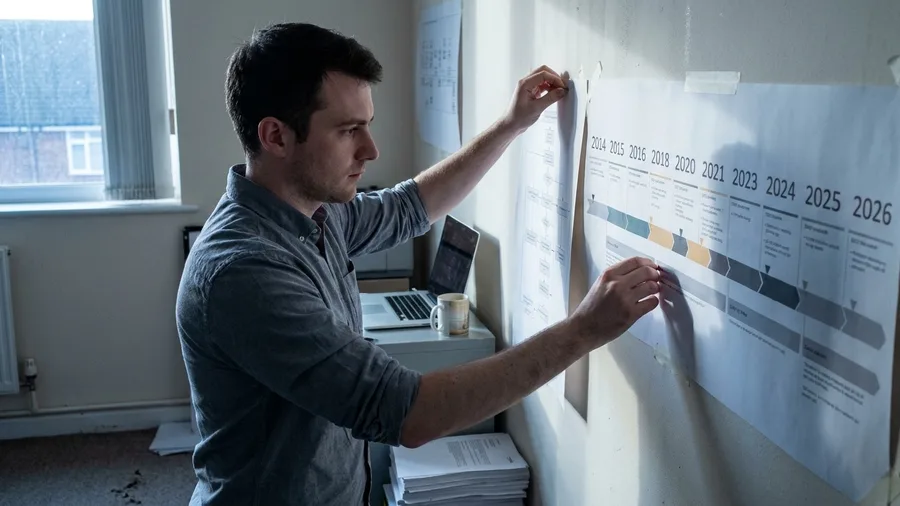
Rockstar built a dedicated internal team for this, and it works on nothing but NPC behavior and population across Leonida. PlayUA reported the setup, and it is a standing build inside the studio, not a feature bolted onto missions near the end.
The record on how long: Jason Schreier reported the NPC interaction prototype dates to 2014, and the art department grew to 10 times its GTA V-era size.
That is twelve years on the idea and a department an order of magnitude larger than the one that built Los Santos.
The work also sits on the simulation systems Rockstar was praised for in Red Dead Redemption 2, released in 2018. Same lineage of authored behavior, carried forward eight years into a new map.
The limit is that schedule time is not tested behavior. No one outside Rockstar has played the shipped population, so time on the clock is the claim being made, not a measured result.
What does back it up: the August 27, 2026 Extended Look was cut from real gameplay running on a PlayStation 5. Those 27 minutes show the shipped kind of reactions, not a target render.
Four claims about Leonida's NPCs, corrected
Sources: 80 Level, PlayUA, 비즈N, Jason Schreier, GamesBeat, Rockstar's official site.
Two pedestrians, two different reactions

Each pedestrian carries a list of authored settings, and the list is why the same pavement gives you two different answers.
Per 80 Level and PlayUA, those settings include temperament, an aggression level, profession, location, what the character has already witnessed, and how the player approaches.
Hold the situation still and change only the list, and the response changes.
Walk up to one person and they run. Try the same block with someone else and you get a complaint or a shove. Nothing about the street changed between those two attempts. The difference is who you picked.
The list is finite. Settings like aggression level and profession are authored buckets, so after a dozen encounters a type starts to show. The variety is real and it is catalogued, which is not the same as infinite.
What that gives the player is a read. Watch a group for a moment and you can pick who will scatter, who will hold their ground, and which one is worth the walk.
Two ways to make NPCs feel alive
Authored simulation (GTA 6)
- Traits and reactions written by a dedicated team since 2014
- Same pedestrian reacts the same way to the same cue tomorrow
- Built on the Red Dead Redemption 2 systems from 2018
- Consistent world, but types repeat once you learn them
Language model at runtime (inZOI, Where Winds Meet)
- inZOI's Smart Zoi run on an on-device small model with NVIDIA ACE
- Where Winds Meet uses LLM chat on a subset of side NPCs
- Dialogue flexes, but replies stay inside a fixed set of flags
- Main story still hand-authored, so the model never touches it
They read how you're holding the gun
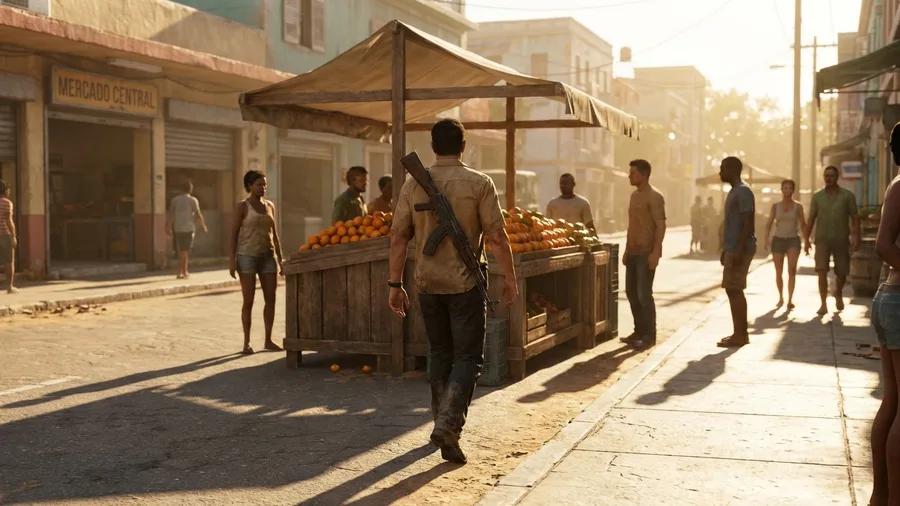
Perception runs off a short list of visible cues, not a guess at what the player wants. Per 80 Level, the game tracks weapon state, following distance and line of sight, which is roughly what a bystander on that pavement could actually see.
Weapon state is the clearest switch. Per 비즈N, a gun slung on the back keeps NPCs calm, and the same gun held in hand makes them back away. Nothing about the character changed; the position of the weapon did.
Three separate cues trigger their own responses. They notice someone eavesdropping, they object to being followed, and they flee from a displayed weapon, per 80 Level.
The catch: the game reads cues, not intent. Walk the same direction a little too long, or stand too close to a conversation, and someone who was never in danger will still spook.
That makes the slung weapon a real habit rather than a detail. Put the gun on the back before a store or a crowd, and the trip goes differently every time.
⚠️ COMMON MISTAKE
Standing still is a cue, too
Idling near a stranger to test the reactions is itself a following-distance cue. NPCs object to being followed, so a test that looks like loitering will get you a suspicious glance before you learn anything. Keep moving, and read the reaction from the walk-past.
Wind decides who hears the conversation

A weapon on your back and your distance from a stranger are cues you carry. The street supplies cues too, and they decide who is in earshot before you do anything.
Alastair MacGregor, Rockstar's Vice President of Audio, told 80 Level that fragments of NPC conversation travel farther depending on the wind. Sound in Leonida is directional, not a fixed circle drawn around a speaker.
Weather works the same way, per Owen Shepherd, Vice President of Art: Light and Rendering. He described conditions as localized, persistent and dynamic, and said the weather systems were completely reimagined for Leonida, according to 80 Level.
A storm sits over a district and stays there. It does not sweep the whole map on a timer.
The catch: Rockstar has described these goals, not how hard either one pulls on NPC decisions. Treat weather as the stage, not the script. Wind will not make a calm pedestrian aggressive.
The payoff is practical. Step upwind of a conversation and the words carry to you; step downwind and they drop away. Position becomes a listening tool, not just a distance check.
Police keep a file instead of respawning

The police work from a written file, not from your position on the map. Officers no longer appear at your shoulder the instant you break a rule.
According to 80 Level, Leonida's law enforcement keeps a record of what it has actually gathered, and that record is what sends them after you.
The file holds names of witnesses and victims, camera footage, and a description: what you wore, how you looked, what you carried, what you drove.
Reports passing between officers let them track your clothes, your car and your companions, per the Korean outlet bizN. The net tightens by degrees rather than snapping shut.
So an alley no longer wipes the slate. In older GTA games, breaking line of sight dropped the wanted level; here the file survives the corner you turned, because it was never built from sight alone.
The switch: a partner who splits off can lower the odds of being spotted, since the description covers company as well as clothing.
That turns escape into preparation. Different clothes, a different car, different company, and the search loses its grip on you. The smart move happens before the job, not in the sprint after it.
This is authored state, not a chatbot

None of this is a language model writing lines on the fly. The reactions come from hand-built systems and stored state, the same family of technique Rockstar was praised for in Red Dead Redemption 2.
A language model is software that predicts likely text; here, nothing is predicted live.
Compare the games that did take that route. inZOI's Smart Zoi characters run on a small language model on the player's own console, built with NVIDIA ACE, and have been in early access since March 28, 2025.
Where Winds Meet added freeform chat to some side characters, fenced to text replies and fixed flags while the main story stays authored.
Those are real attempts, and the fencing in Where Winds Meet is the honest part: the model is kept away from anything that matters.
Rockstar has not published what runs under Leonida, so the claim of the most responsive NPCs in gaming history remains a demo promise, not a benchmark.
Authored reactions repeat. The same pedestrian answers the same cue the same way tomorrow, and that steadiness is what makes a street feel like a place rather than a chat window.
The cost is CPU, and the PC is unconfirmed
Tracking that much authored state per character lands on the CPU, and nobody outside Rockstar has published a number for it. The CPU-heavy expectation comes from TweakTown, described there as a belief rather than a measured result. No system requirements are confirmed for any platform.
The reasoning is easy to follow. More pedestrians holding more recorded circumstances means more checks running every second, even when the player stands still.
That is a plausible reason for load, not a benchmark, so treat it as a question to ask of the launch build and not as a spec.
On platforms, the official site lists PlayStation 5 and Xbox Series X|S with a November 19, 2026 date, and no PC version or PC date.
GamesBeat, citing four industry sources, reports a PC release in the first three months of 2027. Rockstar has not confirmed it, so that window stays a report.
The free move before any money is spent is the 27-minute Extended Look on Netflix, cut from real gameplay on a PlayStation 5.
Digital buyers can start the preload on November 12, 2026, one week out, so the console build is installed and ready before launch night.
Frequently Asked Questions
Do I need a powerful PC to play GTA 6 at launch?
No, because there is no PC version at launch. GTA 6 releases on PlayStation 5 and Xbox Series X|S on November 19, 2026. Rockstar's official site lists no PC version or PC date, so a PC build is not something to plan around until the studio says otherwise.
Are the NPCs in GTA 6 actually AI?
They are authored simulation, not a language model. Rockstar built hand-written traits, perception cues and recorded state onto the systems it used in Red Dead Redemption 2. Games like inZOI and Where Winds Meet do use language models for NPCs, but GTA 6 has not been described that way.
How long has Rockstar been working on the NPC system?
According to Bloomberg reporter Jason Schreier, the prototype of the NPC interaction system dates to 2014. Rockstar also formed a separate internal team dedicated to NPC behavior and population, and the art department grew to 10 times its GTA 5-era size.
Does the wanted system still work like GTA 5?
No. Police no longer spawn on top of you. The game records what law enforcement knows, including witnesses, victims, CCTV, clothing, appearance, weapons and vehicles, then closes a perimeter. Changing clothes or vehicles gives the search less to track.
Is there a PC release date for GTA 6?
Not an official one. GamesBeat reported, based on four industry sources, that a PC version is planned for the first three months of 2027, but Rockstar has not confirmed it. Treat any PC date you see online as unconfirmed until Rockstar publishes one.
When can I preload GTA 6?
Digital preload starts November 12, 2026, one week before the November 19 launch. If you want to play the moment it unlocks, that is the date to have the console ready and the storage free.
A decade of authored behavior, with the model still under wraps
What ships in Leonida is a simulation a dedicated team has staffed since 2014, laid on the foundations of Red Dead Redemption 2. No language model writes those reactions.
The limit is disclosure: Rockstar has described its aims and shown PS5 footage, not published the model or the requirements, so the most-responsive-NPCs claim is credible and unproven at once.
Go back to the pedestrian who ignored the slung rifle and backed off the held one. That is a recorded weapon state meeting an authored aggression level. Watch for it again in the Extended Look rather than take it on faith.
Watch the 27-minute Extended Look on Netflix first. If PS5 or Xbox Series X|S is your platform, preload on November 12, 2026, and hold the early-2027 PC window as unconfirmed until Rockstar says otherwise. Then watch one pedestrian notice the rifle in your hand.