
In the serene twilight of summer, the gently glowing dance of fireflies is a captivating sight.
Flashes of light from these bioluminescent beetles, of which there are around 2,500 species globally, have long been a subject of fascination.
However, the evolutionary journey of their glow remains somewhat elusive.
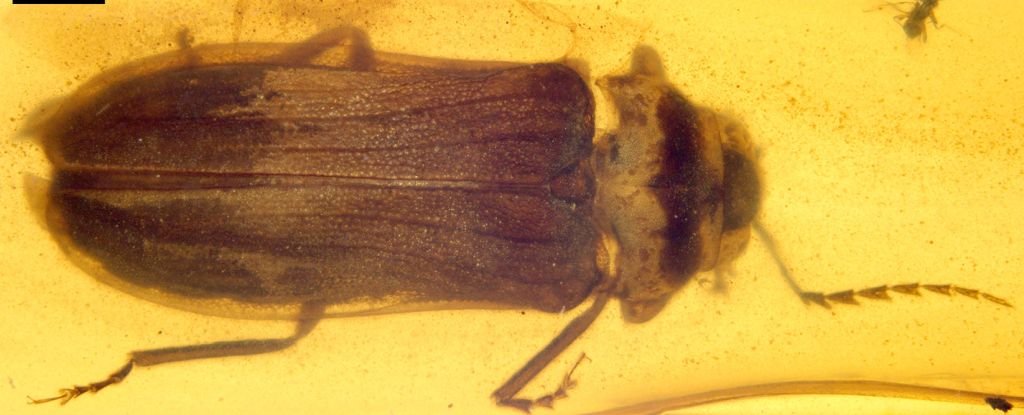
Recent findings led by paleontologist Chenyang Cai from the Chinese Academy of Sciences may hold some intriguing answers.
A firefly, magnificently preserved in rich golden amber from 99 million years ago, demonstrates that its ancestors had already developed their characteristic bioluminescence during the Mesozoic era.
This particular specimen, named Flammarionella hehaikuni, was discovered in Myanmar and marks the second Mesozoic firefly found in such a preserved form.
The previous discovery, Protoluciola albertalleni, also revealed a well-preserved lantern.
Another bioluminescent beetle from a different family was unearthed in the same amber deposit.
The recent discovery is fascinating because the lantern of this firefly differs from those of its Mesozoic contemporaries.
This finding suggests that by 99 million years ago, bioluminescence among insects was already advanced and varied.
Fireflies use their bioluminescence primarily for attraction during courtship and to warn predators of toxins called lucibufagins.
Surprisingly, recent studies propose that bioluminescence existed before these toxins, prompting questions about the initial advantages of this glowing trait.
The amber encasing the fossil provides a clear view of the insect’s intricate details.
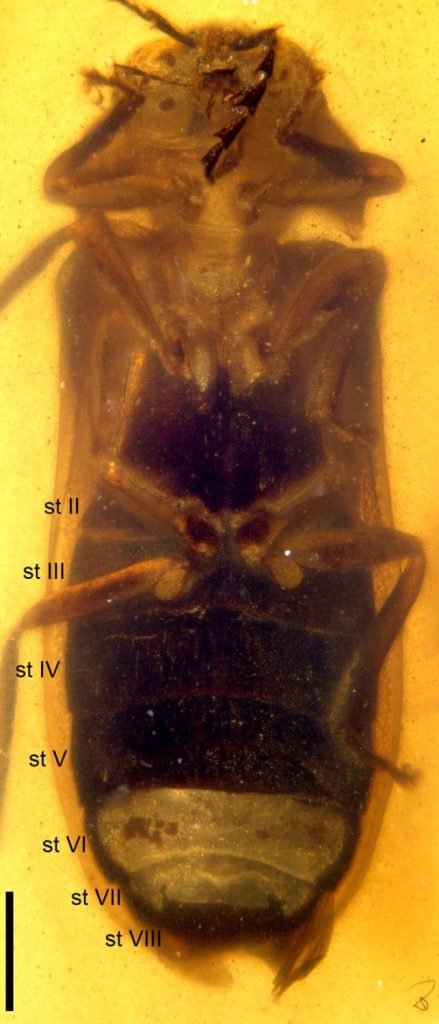
Based on these characteristics, the researchers identified the specimen as a female from the subfamily Luciolinae, known for their flashing abdomen lanterns.
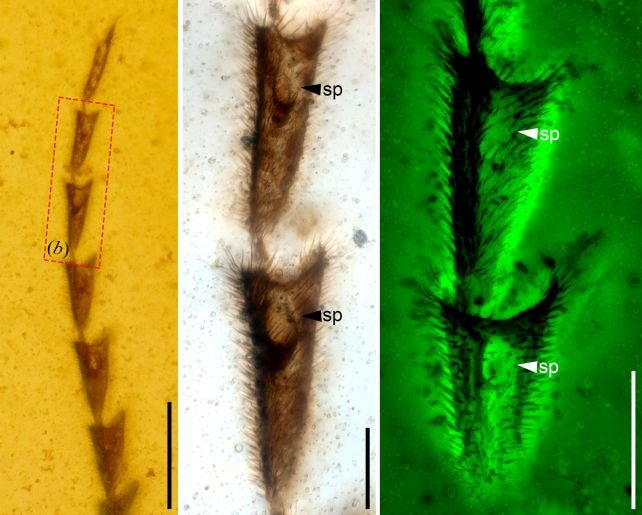
Distinctively, the antennae of Flammarionella, named after French astronomer Camille Flammarion, are densely covered in setae, with deep, oval indentations.
Though not observed in living fireflies, similar indentations relate to the insect’s sense of smell, crucial for recognizing pheromones.
Male fireflies typically have more elaborate antennae, and discovering a male of this species could provide deeper insights.
The fossilized lantern consists of two segments at the insect’s abdomen’s end.
Future comparisons with other Mesozoic bioluminescent insects could illuminate further aspects of their evolution.
Ongoing research aims to uncover more fossilized fireflies and related insects.
As emphasized in their published work in the Proceedings of the Royal Society B: Biological Sciences, the scientists anticipate that future fossil discoveries will unravel more mysteries surrounding the evolution of bioluminescence in these mesmerizing creatures during the Mesozoic era.