
In a groundbreaking animation initially created in 2008 and recently revisited, former NASA scientist Dr. James O’Donoghue has offered a glimpse into a fascinating scenario: what Earth would look like if our oceans vanished.
This visualization not only captivates the imagination but also reveals previously hidden features of our planet.
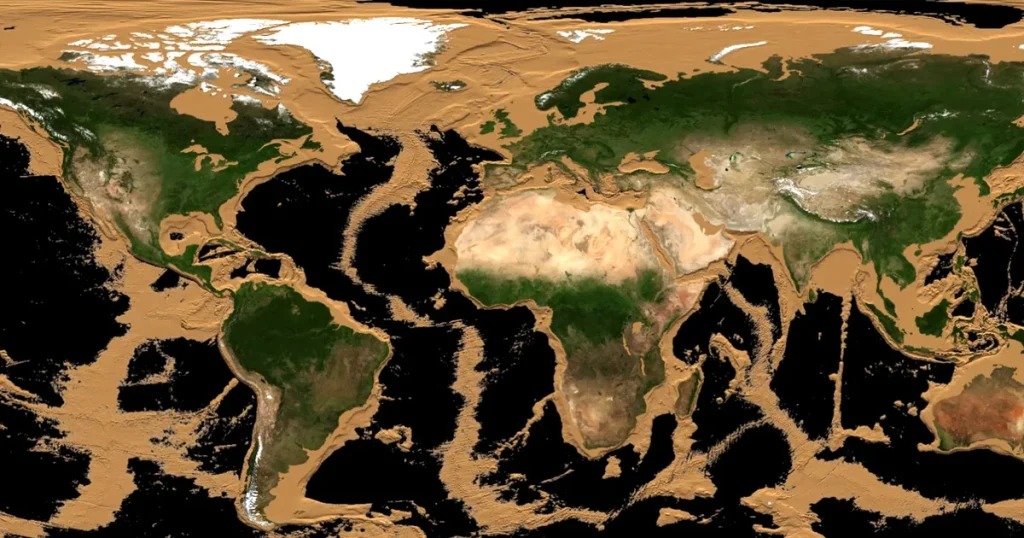
Imagine draining away the world’s oceans, uncovering a network of underexplored mountains and landscapes.
This is precisely what Dr. O’Donoghue’s high-resolution, slowed-down animation achieves, showcasing never-before-seen geological structures on the ocean floor.
It raises curiosity about potential underwater exploration.
The animation begins with water levels quickly dropping, unveiling intricate undersea terrains within the first few meters.
Dr. O’Donoghue notes this swift transformation, which lays bare a rich tapestry of underwater landscapes.
These insights remind us that, like continents, the ocean floor is diverse and intriguing.
Diving deeper, an imaginary journey takes viewers to depths of up to 10,000 meters, draining most water by around 5,000 meters.
However, Earth’s deepest trenches remain to be fully emptied, highlighting the immense depth of these natural formations.
The animation underscores the unknown mysteries waiting in our oceans’ depths.
This visualization draws attention to historical land bridges that emerged during the Last Glacial Maximum (LGM) approximately 26,000 to 19,000 years ago.
During this period, much of Earth’s water was locked in glacial formations, lowering sea levels by about 125 meters.
These ancient bridges connected continents and islands, facilitating early human migration.
Imagine our ancestors crossing from continental Europe to what is now the United Kingdom, or traversing from Alaska to the distant reaches of Russia.
These journeys were possible due to land bridges exposed by significantly lower sea levels. The animation offers a window into this critical era of human migration.
Notably, the animation reveals oceanic ridges, strings of volcanoes formed by the splitting ocean crust.
These features are exposed after several hundred feet of sea-level reduction, demonstrating the dynamic geological processes shaping our planet.
Relax, though, as there’s no imminent danger of our oceans drying up entirely.
The animation serves as a thought-provoking exercise, drawing attention to Earth’s hidden features and their significance in early human history.
As we ponder the Earth’s trails of the past, we glimpse a vision of what future ice ages might bring.
For now, the mysteries of our oceans remain, challenging us to explore and unravel their secrets.
The animation is a reminder of the unexplored world that lies beneath the waves, waiting to share its complex narratives with humanity.