
Engineers from King’s College London (KCL) have crafted an innovative approach to building robots that function without the need for electricity.
Instead, these robots rely on a distinctive fluid-based circuit design, which allows them to perform a variety of complex actions through pressure signals.

This exciting development could pave the way for robots to operate in environments where conventional electricity sources are either unavailable or unreliable, such as areas with high radiation levels or sensitive electronic environments like MRI rooms.
Imagine the possibilities in places like Chernobyl, where electrical equipment tends to fail due to intense irradiation.
The core idea revolves around the concept of a circuit within these robots, one that eschews traditional electricity in favor of fluid pressure to convey commands.
This mimics the way biological bodies operate, where messages are transmitted without any central control.
Remarkably, the circuits use a flexible valve that functions akin to a transistor.
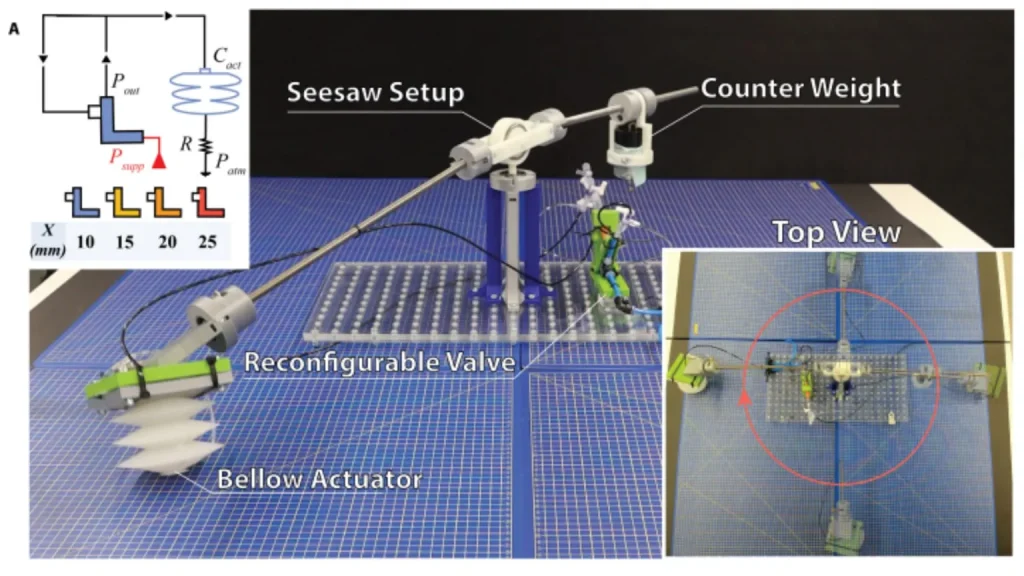
Changes in fluid pressure act much like binary code, providing a mechanism to control actions similar to how traditional electronic encoders operate.
This advancement reduces reliance on electronic circuits, freeing up space for powerful AI-driven systems and minimizing computational burdens.
Soft robotics, which tend to emphasize flexible materials for safer interactions, traditionally depend on rigid electronics for their operations, creating challenges in performing complex tasks.
However, with this new design, the technology promises increased dexterity and capability, enabling tasks like gripping and manipulation without extensive software strain.
Furthermore, an ingenious aspect of the project’s mission is to craft these robots for use in regions with problematic electrical infrastructure.
In areas where electricity is scarce or unstable, these robots provide a promising solution by bypassing traditional power needs entirely.
This has significant implications for low-income territories around the world, enhancing automated processes where previously infeasible.
Despite the groundbreaking nature of this fluid-based communication, the journey is ongoing.
Anticipated challenges remain, particularly in scaling the circuits for larger and more complex robotic systems.
Ensuring they can adapt to varying pressures and environments continues to be a key focus.
The researchers aim to upscale these fluid circuit designs for deployment in extensive robotics applications, including robots that can monitor power plants with agile, wheeled mechanisms steeped in this new soft engineering.
Overall, this innovation marks a significant step towards the evolution of robotics, hinting at an era where adaptability, resilience to environmental challenges, and reduced dependency on electricity redefine what robots can achieve.