
Astronomers have made a thrilling discovery of an Earth-like exoplanet orbiting a white dwarf star, providing fascinating insights into the future of our solar system.
The planet, which has about 1.9 times the mass of Earth, was detected at twice the distance from its star compared to Earth’s distance from the Sun.
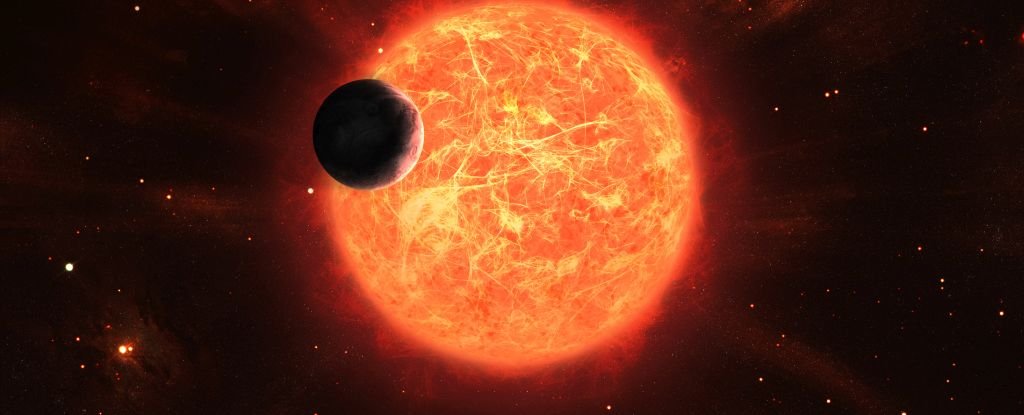
However, there’s a significant twist—this planet likely experienced severe conditions as its host star transformed from a red giant to a white dwarf, phases of stellar evolution that our Sun will eventually undergo.
The research, led by Keming Zhang at the University of California, highlights how planets might endure these chaotic periods, ushering us into a deeper understanding of planetary survival and evolution.
White dwarfs are the remnants of stars like our Sun, which exhaust their hydrogen fuel, grow unstable, and expand significantly during their red giant phase.
Eventually, these stars shed their outer layers, and their cores collapse under gravity to form dense and hot white dwarfs, which then cool over trillions of years.
The discovery of this exoplanet is particularly intriguing as it suggests the possibility of planet survival through the red giant phase.
Most predictions have considered the destruction of planets orbiting stars that become red giants.
Yet, here lies evidence of a planet that might have narrowly escaped destruction.
The detection method used, known as microlensing, occurs when the light from a distant star is magnified by the gravitational field of another object in the line of sight.
In this case, a more distant star perfectly aligned with the white dwarf, causing a magnification effect that allowed the researchers to detect the planet.
“The white dwarf lens was nearly perfectly aligned with the background source star, causing it to be magnified by over 1,000 times,” Zhang explained.
“For these rare ultra-high magnification microlensing events, even a terrestrial planet can significantly affect the magnification pattern, enabling us to accurately infer the lens configuration.”
This microlensing also revealed the presence of a brown dwarf orbiting the white dwarf.
A brown dwarf is an object about 30 times the mass of Jupiter, too massive to be a planet but not massive enough for hydrogen fusion like a star.
Interestingly, the detected exoplanet’s current orbit is about 2.1 astronomical units (AU) from the white dwarf, closely matching the expected location of Earth after our Sun becomes a white dwarf.
“Models currently disagree on whether Earth will be engulfed during the Sun’s red giant phase, but our discovery suggests that Earth might narrowly escape, just like this exoplanet,” Zhang noted.
As our Sun ages, it grows hotter and brighter, a process that will eventually make Earth inhospitable to life as we know it, with all its water evaporating in about a billion years.
However, as the Sun becomes a red giant, the habitable zone—where conditions might support life—will shift outward toward the orbits of Jupiter and Saturn, possibly turning their moons into ocean planets.
By the time the Sun’s red giant phase begins, life on Earth will either have ceased or transformed dramatically.
This discovery provides a sneak peek into such a distant future and underscores the resilience of planets during catastrophic stellar evolutions.