
Octopuses, often perceived as solitary and enigmatic creatures, are breaking stereotypes with their surprising social behavior.
A new study published in the journal Nature reveals that some members of the species Octopus cyanea, commonly known as the big blue or day octopus, hunt collaboratively with groups of fish.
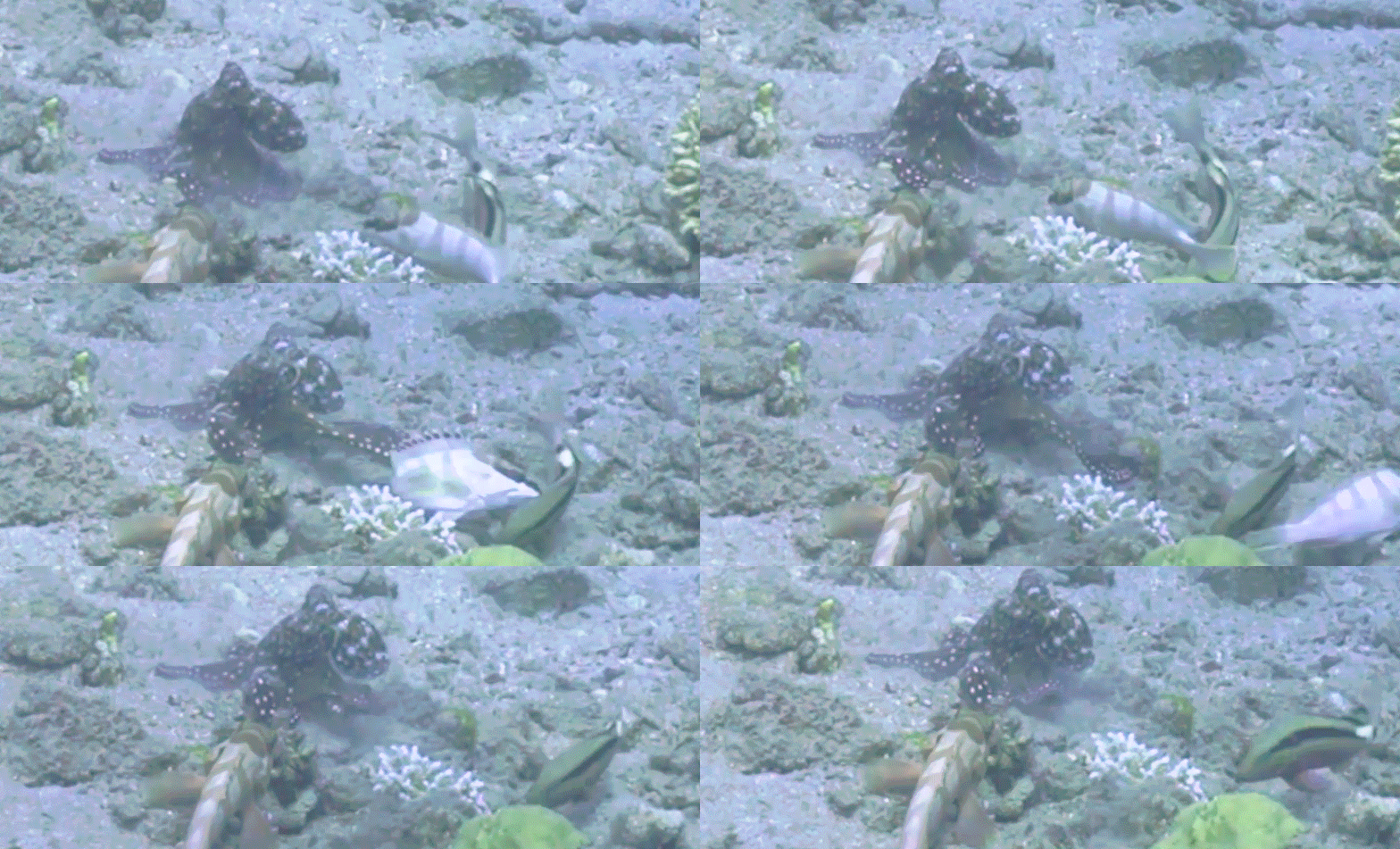
Researchers from the Max Planck Institute of Animal Behavior dived off the coast of Eilat, Israel, to observe and record the behavior of 13 octopuses over 120 hours.
They documented 13 different hunts involving the octopuses and fish groups, which included species such as grouper and goatfish.
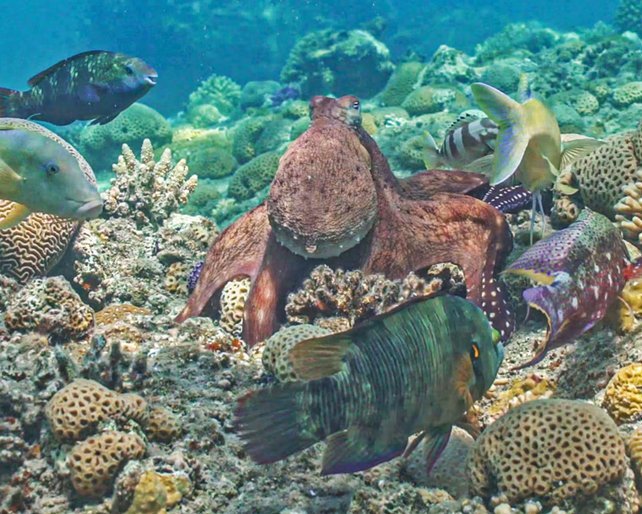
The findings are fascinating: the octopuses and their fish companions appear to organize their hunts collectively, deciding together on their prey.
Interestingly, the octopuses even punch their fish partners to keep them on track and contributing to the hunt.
This behavior indicates a sophisticated level of social interaction and coordination, marking a significant departure from the previously held belief that octopuses are strictly solitary hunters.
Lead researcher Eduardo Sampaio explains, “We are very similar to these animals. In terms of sentience, they are at a very close level or closer than we think toward us.”
The study shows that octopuses use their ability to reach into crevices to flush out prey, which the fish then catch.
Conversely, the fish lead the octopuses to potential prey, saving the cephalopods from aimless searching. This mutual benefit strengthens the hunting group’s efficiency.
Even though the octopuses do not appear to lead the hunting groups, they do play a crucial role.
They punch fish like blacktip groupers, known for being less active and trying to exploit the work of others in the group.
These punches keep such fish engaged and contribute to the group’s success.
“If the group is very still and everyone is around the octopus, it starts punching, but if the group is moving along the habitat, this means that they’re looking for prey, so the octopus is happy. It doesn’t punch anyone,” Sampaio notes.
Using advanced software, the researchers converted their video footage into a three-dimensional representation to analyze the social dynamics within these groups.
They found that certain species, like the blue goatfish, often took the lead in exploring, while the octopus decided when and where to hunt.
This discovery also shifts perspectives on octopus intelligence.
Scientists have long debated how these creatures developed such high intelligence despite their solitary nature.
This study supports the theory that social interactions, even between different species, may have driven their cognitive abilities.
“Octopuses were seen as a problem case because they are intelligent and yet solitary, it was assumed, so researchers puzzled for a long time about what’s going on there,” explains Jonathan Birch, a professor of philosophy at the London School of Economics who was not involved in the study.
The research opens new avenues for understanding the social capabilities and cognitive complexity of marine life.
It challenges previous assumptions and highlights the intricate and adaptable social behaviors observed in the wild.
These findings underscore the importance of observing animals in their natural habitat as much as possible.
As Sampaio concludes, “These results broaden our understanding of leadership and sociality, emphasizing the complexity and adaptability of social interactions in nature.”