
A peculiar observation in the cosmos may have led astronomers to one of the most sought-after objects in our galaxy.
Approximately 5,825 light-years from Earth, a red giant star, named G3425, has been exhibiting unusual movements, suggesting it has a binary companion.
The twist? There’s no light emanating from where this companion should be.
Upon closer analysis, astronomers led by Song Wang from the Chinese Academy of Sciences determined that the mass of this invisible object is roughly 3.6 times that of our Sun.
This pinpointed the invisible companion as a black hole, one that intriguingly falls within a rarely observed range known as the lower mass gap.
In their paper, the researchers highlighted the broader implications of G3425.
“The discovery provides evidence for the existence of mass-gap black holes in non-interacting binaries, which are difficult to detect through X-ray emissions,” they explained.
This underscores the potential this discovery holds for advancing our understanding of such elusive celestial phenomena.
Black holes are remnants of massive stars that, exhausted of their fuel, collapse under their own gravity.
They form part of a continuum that includes white dwarfs and neutron stars. White dwarfs, formed from stars up to eight times the Sun’s mass, cap out at about 1.4 solar masses.
Neutron stars, denser yet, typically peak around 2.3 solar masses. Beyond this threshold, the intense inward pressure causes the object to collapse into a black hole.
However, astronomers have detected very few black holes below five solar masses, giving rise to the so-called mass gap.
This has long posed a question: Are we missing these black holes due to detection challenges, or is there a fundamental reason preventing their formation?
The European Space Agency’s Gaia mission, mapping the Milky Way in three dimensions, plays a crucial role in addressing this mystery.
By observing stellar motions and velocities, Gaia helps identify stars like those in binary systems where one partner is seemingly invisible, potentially revealing previously hidden black holes.
Through Gaia’s data and the Chinese Academy of Science’s Large Aperture Multi-Object Spectroscopic Telescope, Wang’s team scrutinized the light changes of the red giant star.
Their findings showed that the 2.7 solar mass red giant is in a wide, circular orbit taking about 880 days to complete, around an unseen partner of approximately 3.6 solar masses.
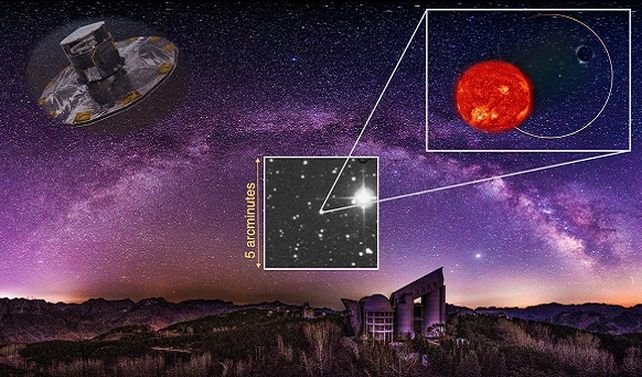
This circular orbit is particularly intriguing. Typically, stellar-mass black holes in binaries have elliptical orbits, disrupted by the supernova explosions that formed them. The undisturbed, circular orbit observed in G3425 challenges existing theories on the dynamics of such binaries.
The discovery of G3425 opens up new avenues for understanding how low-mass black holes form and behave. The team suggests that future spectroscopic and astrometric observations could unveil a population of low-mass black-hole binaries, offering deeper insights into their formation and evolution.
Their findings have been published in the journal Nature, marking a significant milestone in the quest to uncover the hidden facets of black hole formation and the dynamics of binary star systems.