
Once upon a time, Earth may have sported a planetary ring of its own.
While this ring didn’t last long in cosmic terms, it might have existed long enough—tens of millions of years—to leave a lasting mark on Earth’s geological history.
A recent study led by planetary scientist Andy Tomkins of Monash University in Australia points to this intriguing possibility.
Tomkins and his team focused on an unusual increase in meteorite impacts, known as the Ordovician impact spike.
Their analysis suggests that a slowly decaying ring orbiting Earth could plausibly explain this anomaly. “I like to think about what the Earth might have looked like with a ring around it, a very different look compared with today,” Tomkins said.
Evidence supporting this ring theory comes from the clustering of craters and the high levels of meteorite debris found in sedimentary rocks from the Ordovician period.
The researchers analyzed 21 craters that formed during this impact spike and found that they were all located within 30 degrees latitude of the equator.
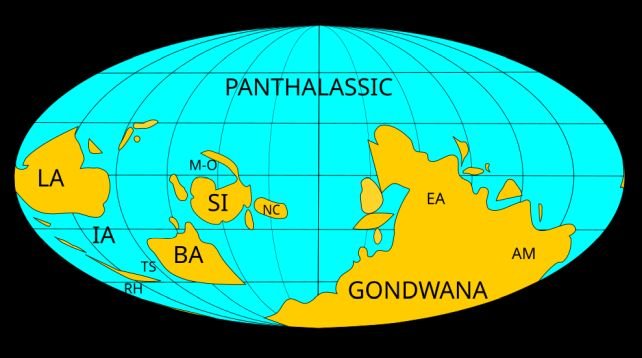
During the Ordovician, Earth’s continents were part of a supercontinent called Gondwana, which has since broken up and drifted apart.
Interestingly, these craters were not just closely spaced in time but also in location, suggesting that the meteorite impacts were confined to about 30 percent of the exposed landmass, all within the equatorial region.
This finding hints at the possibility that these meteorites originated from a narrow band of rocky debris, potentially a ring, that encircled Earth’s middle latitudes.
According to the research, about 466 million years ago, an asteroid may have entered Earth’s gravity field, being torn apart by tidal forces at a boundary known as the Roche limit.
This process would have generated debris that could orbit Earth in a relatively stable but decaying trajectory, eventually falling to Earth and creating the observed Ordovician impact spike.
Similar phenomena have been observed elsewhere in the Solar System. Saturn’s rings are temporary and currently falling onto the planet at a rapid rate.
Comet Shoemaker-Levy 9 experienced a similar fate in 1994 when it was torn apart by Jupiter’s gravity, with its debris circling the planet for years.
The clustering of the craters and the high levels of meteorite material in sedimentary layers of the same timeframe provide strong evidence that a disintegrated asteroid could have caused such a ring.
Another potential clue is linked to the significant climate changes at the end of the Ordovician period, around 445 million years ago, which ushered in one of Earth’s coldest ice ages.
While highly speculative at the moment, Tomkins suggests that a ring could have intensified this ice age by casting a shadow over Earth’s surface. To explore this hypothesis further, detailed numerical modeling is necessary.
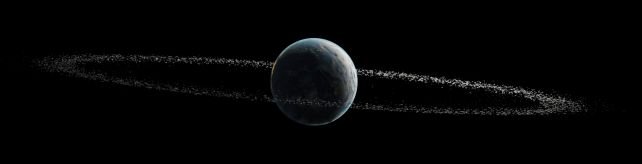
This modeling would simulate the break-up of the asteroid, ring formation, and its subsequent evolution, determining if a ring could significantly impact Earth’s climate.
If this theory holds, it could offer new insights into understanding Earth’s climatic history and the rapid evolution of life during the Great Ordovician Biodiversification Event.
Tomkins also proposes an imaginative albeit preliminary idea: creating a ring around an overly hot planet like Venus by guiding a large asteroid into a break-up orbit to induce cooling.
While terraforming Venus isn’t on the immediate horizon, the concept certainly sparks curiosity about our Solar System’s dynamic history and Earth’s evolving environment.
The research has been published in the journal Earth and Planetary Science Letters.